HTB Academy - Web Requests
HTB Academy - Web Requests: Keep a crisp, practical explainer of HTTP requests, responses, headers, and methods/status codes—with raw examples and copy‑paste cribs. This is the version I actually reference during testing. • HTB Academy • headers, htb-academy
🎯 Objective
Keep a crisp, practical explainer of HTTP requests, responses, headers, and methods/status codes—with raw examples and copy‑paste cribs. This is the version I actually reference during testing.
🌐 Big Picture
HTTP exchanges are a client request (browser/cURL) and a server response (web server/app). The request carries the target resource (URL/path/params), headers, and optionally a body. The server processes it and replies with a status code, headers, and often a response body.
HTTP/1.x is text‑based (newline‑delimited). HTTP/2 is binary/framed (HPACK, streams), but concepts—methods, status, headers—carry over.
📤 HTTP Request (anatomy)
Example request (GET a login page):
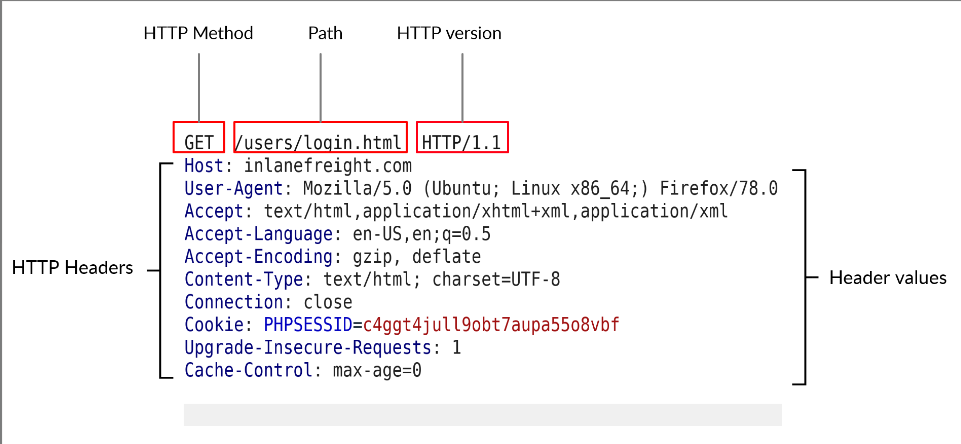
Request line has three space‑separated fields:
| Field | Example | Description |
|---|---|---|
| Method | GET | Verb indicating action |
| Path | /users/login.html | Resource path; may include a query string like ?username=user |
| Version | HTTP/1.1 | Protocol version |
Then headers (name: value), then an empty line, then (for methods like POST/PUT/PATCH) an optional body.
📥 HTTP Response (anatomy)
Example raw response:
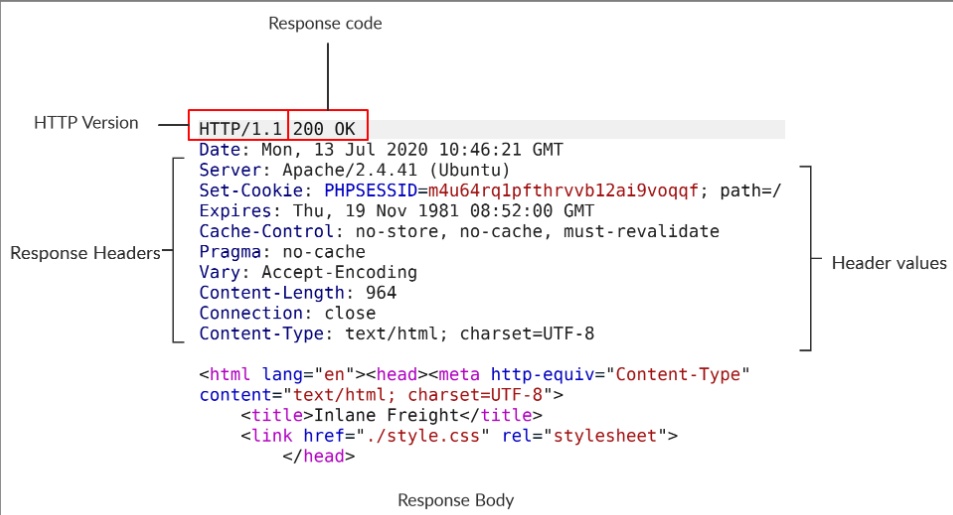
Status line: HTTP/1.1 200 OK → protocol + status code + reason.
Followed by headers and an optional body (HTML, JSON, images, PDFs, etc.).
🏷️ HTTP Headers (types)
General headers
Describe the message rather than its content (used on requests and responses).
| Header | Example | What it does |
|---|---|---|
Date | Date: Wed, 16 Feb 2022 10:38:44 GMT | When the message originated (prefer UTC). |
Connection | Connection: close | close or keep-alive to control TCP reuse. |
Entity headers
Describe the content entity (commonly in responses, or POST/PUT bodies).
| Header | Example | What it does |
|---|---|---|
Content-Type | Content-Type: text/html; charset=UTF-8 | MIME type + charset. |
Content-Length | Content-Length: 385 | Byte length of body. |
Content-Encoding | Content-Encoding: gzip | Transform like gzip/deflate/br. |
boundary | boundary="b4e4fbd93540" | Multipart delimiter for mixed parts. |
Media-Type | application/pdf | (Alias used in some docs; MIME governs behavior.) |
Request headers
Used by the client; not about the message body itself.
| Header | Example | What it does |
|---|---|---|
Host | Host: www.inlanefreight.com | Virtual host selection on the server. |
User-Agent | User-Agent: curl/7.77.0 | Client identifier. |
Referer | Referer: https://google.com/ | Where the request came from (spoofable). |
Accept | Accept: */* | Media types the client accepts. |
Cookie | Cookie: PHPSESSID=b4e4fbd93540 | Client cookies (name=value; multiple via ;). |
Authorization | Authorization: Basic cGFzc3dvcmQ= | Client auth (Basic/Bearer/etc.). |
Response headers
Used by the server; not about the body content.
| Header | Example | What it does |
|---|---|---|
Server | Server: Apache/2.4.57 | Server software/version hint. |
Set-Cookie | Set-Cookie: PHPSESSID=b4e4...; HttpOnly; Secure | Instructs client to store cookies. |
WWW-Authenticate | WWW-Authenticate: Basic realm="local" | Signals required auth scheme. |
Security headers
Policies to harden browser behavior.
| Header | Example | What it does |
|---|---|---|
Content-Security-Policy | Content-Security-Policy: script-src 'self' | Restricts script sources; mitigates XSS. |
Strict-Transport-Security | Strict-Transport-Security: max-age=31536000 | Force HTTPS (HSTS). |
Referrer-Policy | Referrer-Policy: origin | Controls Referer exposure. |
Note: Apps can emit custom headers as needed.
📨 Methods (verbs)
Common ones you’ll see/testing basics:
| Method | What it does |
|---|---|
GET | Retrieve a resource. Query via URL params. |
POST | Send data in body (forms, uploads, JSON). |
HEAD | Like GET but only headers (no body). |
PUT | Replace a resource (full update, often idempotent). |
PATCH | Partial update of a resource. |
DELETE | Remove a resource. |
OPTIONS | Discover server capabilities (allowed methods). |
Many modern apps use mostly GET/POST; RESTful APIs often use PUT/DELETE/PATCH for updates.
🔢 Status codes (families)
- 1xx: Informational (rare in browsing).
- 2xx: Success (e.g., 200 OK).
- 3xx: Redirects (e.g., 302 Found).
- 4xx: Client errors (e.g., 400 Bad Request, 403 Forbidden, 404 Not Found).
- 5xx: Server errors (500 Internal Server Error).
Quick examples:
- 200 OK – Success; body contains the resource.
- 302 Found – Temporary redirect (often after login).
- 400 Bad Request – Malformed request (missing newline, bad JSON).
- 403 Forbidden – Authenticated but not authorized (or input flagged).
- 404 Not Found – Resource doesn’t exist.
- 500 Internal Server Error – App/server blew up handling it.
📎 Copy‑paste crib
See exactly what cURL sends (HTTP/1.1):
curl -v http://example.com/ -H 'Accept: text/html'Send JSON (with correct content type):
curl -sS -X POST 'https://api.example.com/items' -H 'Content-Type: application/json' -d '{"name":"demo","enabled":true}'HEAD only (check size/headers without body):
curl -I https://example.com/big.isoTrace raw over TLS (handy when debugging headers):
openssl s_client -connect example.com:443 -servername example.com
# then paste an HTTP/1.1 request:
# GET / HTTP/1.1
# Host: example.com
# Connection: close
#
OPTIONS to see allowed methods:
curl -i -X OPTIONS https://api.example.com/resource🧪 Troubleshooting
- 415/400 → Content‑Type mismatch or malformed JSON.
- CORS in browsers → Use server‑side or cURL (CORS is a browser policy).
- Auth woes (401/403) → Recheck
Authorization/cookies; capture via DevTools and replay. - Chunked vs length → Servers may use
Transfer-Encoding: chunkedinstead ofContent-Length. - HTTP/2 gotchas → Intermediaries may coalesce headers; use
--http1.1if behavior differs.
✅ TL;DR
- Request = method + path + version + headers + body (optional).
- Response = version + status + headers + body (optional).
- Know the header categories, the core verbs, and the status families.
- When stuck, capture in DevTools and replay with cURL—then iterate.
Comments
Comments
Loading comments…