Automatic Litter Box – Wormgear implementation
A heavy drum kept backdriving my NEMA 23 motor due to gravity. Instead of holding torque electronically, I turned to Reddit for advice. The solution? A self-locking worm gear. A simple mechanical fix that works with physics — not against it.
Solving Backdriving in My Litter Box Mechanism
One of the most humbling lessons in this project came from something simple: gravity.
I’m using a NEMA 23 stepper motor driving a small pinion gear. That pinion meshes with a much larger gear attached to the litter box drum. When the motor turns, the drum rotates exactly as intended.
But when the motor stops?
The weight of the drum rotates the large gear backwards…
which drives the motor backwards.
Classic backdriving.
Instead of guessing my way through the solution, I asked the Reddit for help since I am not super experienced with this kind of mechanics/engineering
🤝 Learning From the Community
I explained the situation:
- Heavy rotating drum
- Small pinion → large gear
- When power stops, gravity wins
- Motor gets forced backward
I asked:
What is the simplest, most practical way to prevent backdriving without keeping the motor energized 24/7?
I had been looking into:
- Worm gears (self-locking)
- Adding a motor brake
- Ratchet mechanisms
The answers were surprisingly consistent.
If you want something simple, mechanical, reliable, and elegant?
Use a worm gear.
🔩 Why a Worm Gear Is the Smart Solution
A worm gear has a powerful property:
It can easily drive the wheel forward…
but the wheel cannot drive the worm backward.
That means:
✔ Motor turns drum
✔ Drum cannot turn motor
✔ No power required to hold position
✔ No brake needed
✔ Pure mechanical self-locking design
Sometimes the best solution isn’t electronic — it’s geometric.
🐾 Original Gear Setup (Before the Fix)
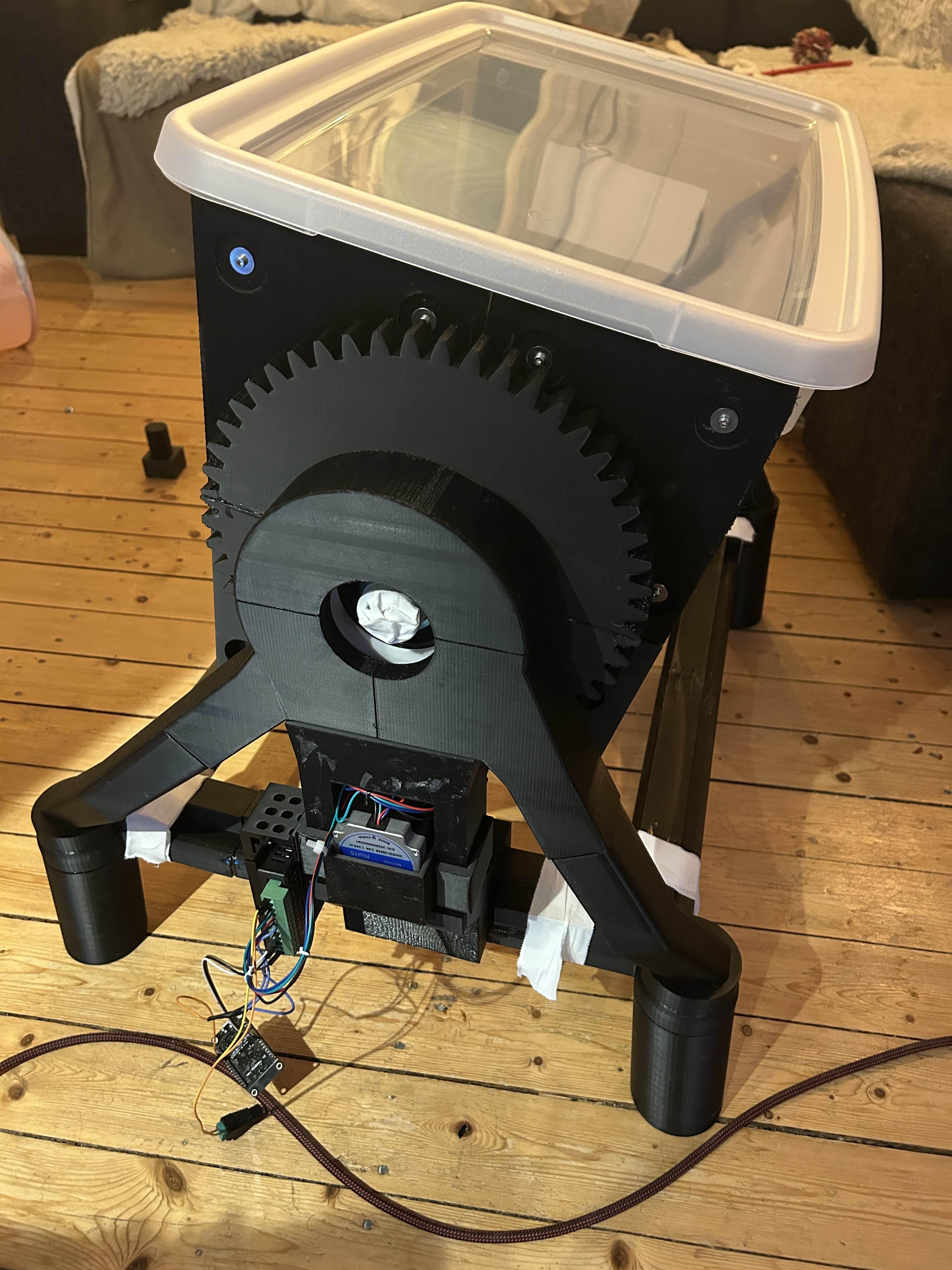
In this version you can clearly see:
- Large printed gear attached to the drum
- Pinion driven by the NEMA 23
- Exposed test setup for debugging
Mechanically solid — but vulnerable to gravity.
🧪 Developing the Worm Gear Prototype
After the feedback, I started developing a compact worm gearbox:
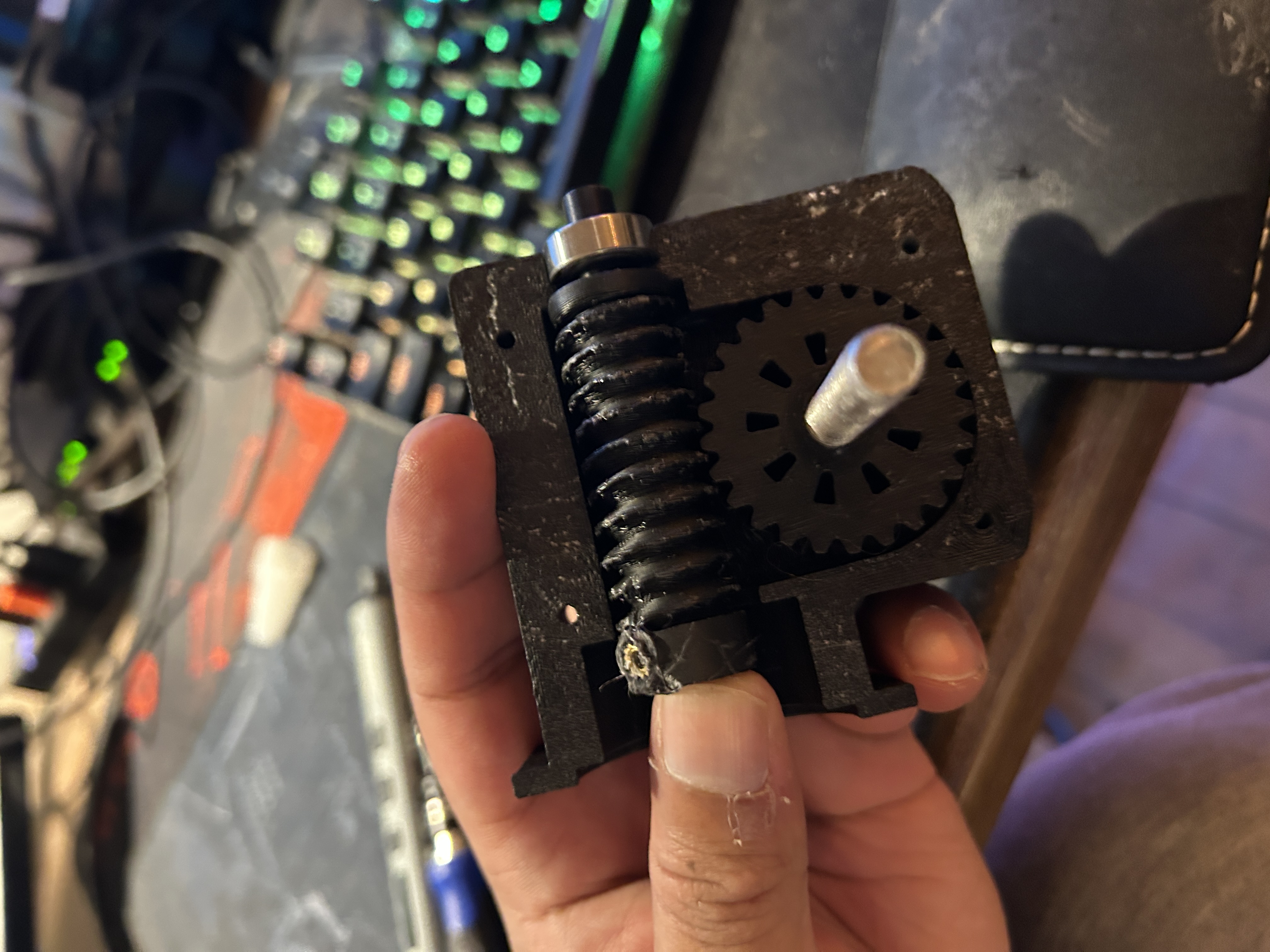
This prototype includes:
- 3D-printed worm screw
- Matching worm wheel
- Steel shaft support
- Compact housing frame
Still refining tolerances, friction behavior, and strength — but the principle works exactly as described.
🧠 What I Learned
At first, I thought in terms of:
“How do I force the motor to hold?”
The better question turned out to be:
“How do I design the system so it doesn’t need to hold?”
That shift changes everything.
It’s the difference between:
- Fighting physics
- Working with physics
🚀 Next Steps
I’m currently refining:
- Gear tooth strength
- Bearing alignment
- Lubrication strategy
- Backlash minimization
Once finalized, this will eliminate backdriving entirely and make the litter box more power-efficient and mechanically reliable.
Sometimes engineering wisdom is simply knowing when to ask.
Comments
Comments
Loading comments…